Posts by Bonk
2015 – Book – The Insurance Forum – Chapter 5 – The A.L. Williams Replacement Empire, by Joseph Belth – 15p
2015 - Book - The Insurance Forum - Chapter 5 - The A.L. Williams Replacement Empire, by Joseph Belth - 15p
- 2015 - Book - The Insurance Forum - Chapter 5 - The A.L. Williams Replacement Empire, by Joseph Belth --- [BonkNote] --- 15p
- 1 - Often ALW sold an annuity rider attached to the tern life policy to provide for the accumulation of savings.
- 1-2 - Although life insurance companies and agents who act in a professional manner usually try to avoid replacement activity, for reasons discussed in chapter 4, most of ALW's business involved replacement of existing cash-value life insurance policies. ALW's sales organization was of the multi-level marketing type-some critics called it a pyramid-with mostly part-time representatives at the lower levels of the organization and mostly full-time representatives at the higher levels.
- 2 - ALW's Activities
- At least seven characteristics of ALW's activities infuriated other life insurance companies and agents.
- replacements
- Third, ALW recruited huge numbers of part-time representatives and required each recruit to buy a policy on the recruit's own life. Thus there was a blurring of the distinction between the recruitment of representatives and the sale of life insurance.
- ALW trained its representatives to denigrate the full-time representatives of other life insurance companies
- Sixth, ALW sought to suppress negative material. A vivid example of this practice - ALW's 1981 attack on the Forum and me described later in this chapter.
- Seventh, ALW criticized other life insurance companies harshly:
- For example, at sales meetings it displayed large banners reading "Wet on Met" and "Pee on Pru." Williams himself described other companies' agents as 'low life" and scum."
- At least seven characteristics of ALW's activities infuriated other life insurance companies and agents.
- 55 - The conclusion of my April 1981 article became important in subsequent developments. Here is the full section:
- ....an inordinate emphasis on the alleged opportunity for sales representatives to get rich quick. The organization displays some of the characteristics of a chain letter, and like a chain letter will sooner or later run out of prospective recruits and prospective customers. Until the operation runs its course, however, we fear that many people are going to be seriously hurt. Among those to be hurt
are ... persons who enter the organization with high hopes that are dashed. - 55-56 - it is our opinion that the ALW organization is engaged primarily in the churning of life insurance.
- The ALW Attack on the Forum and Me
- On October 28 I received a copy of the Raxter letter from a Pennsylvania agent of Prudential Insurance Company of America. That was my first knowledge of the letter. It was also my first knowledge that ALW was using the letter as the centerpiece of a national campaign to discredit the Forum and me, and to intimidate agents who were trying to protect their policyholders against ALW's replacement activities.
- On November 4 I wrote to Raxter requesting several items. He responded on November 16. He sent me a copy of the den Boer letter. It said that ALW disagrees strongly with the last paragraph of my article, and that unauthorized distribution of the article by agents in their conservation efforts is an unfair trade practice under North Carolina laws and regulations.
- Raxter finally sent me the circular letter. It said in part that "statutes and regulations of this State ... specifically prohibit the sale or conservation of life insurance on the basis of the negative aspects of competing products and companies." I found that statement totally at odds with his cited sections of the law.
- In response to my request for a list of the "allegations" and "opinions" the Department considers "inaccurate" or that "tend to create an inaccurate impression in the mind of the customer," he said "there exists no Departmental record of that nature," and he referred me to the den Boer letter.
- 59 - Our Lawsuit against Ingram
- On December 31 Vladeck filed a lawsuit on my behalf against Ingram in the U.S. District Court in Raleigh. We asked the court to do three things: (1) declare that Ingram had acted in violation of the U.S. Constitution in suppressing distribution of the Forum article, (2) order Ingram to rescind the Raxter letter, and (3) preliminarily and permanently enjoin Ingram from threatening or taking disciplinary action against insurance companies or insurance agents based upon distribution to consumers of materials discussing negative aspects of competing products and companies so long as the materials are not untrue, deceptive, or misleading.
- On April 6, 1983, the court granted our motion for summary judgment. The court ordered Ingram not to suppress distribution of the April 1981 article unless and until it was determined to be subject to suppression under applicable North Carolina laws and regulations. The court decreed that, in the event the article was determined to be subject to suppression, we be afforded at least 20 days' notice and an opportunity to be heard before measures were taken to suppress distribution. The court retained jurisdiction to resolve our claim for attorney fees.
Ingram appealed the decision to the U.S. Court of Appeals for the Fourth Circuit in Richmond, Virginia. On February 27, 1984, at oral argument on the appeal, a three-judge panel unanimously affirmed the district court decision from the bench without requesting oral argument from Vladeck. - On May 8, 1984, the district court awarded us $20,500 in attorney fees and $1,500 in expenses. On June 14, 1984, checks in those amounts were drawn against the Department's account, and the legal battle ended.
- 60 - Ingram's Kangaroo Hearing
- 64 - Other Articles about ALW
- Following the excitement generated by my first article about ALW, I received from readers a large and steady stream of information about the activities of ALW. As a result, during the period from April 1981 to November 1990, I wrote 50 articles about ALW in 39 issues of the Forum. A few of the articles are discussed briefly here.
- The Saturday Evening Post Incident
- 65 - The U.S. Congress Incident
- 66 - The Southern Illinois University Incident
- 67 - Alan Press
- He felt the activities of ALW were a serious threat not only to life insurance consumers but also life insurance companies.
- ....an inordinate emphasis on the alleged opportunity for sales representatives to get rich quick. The organization displays some of the characteristics of a chain letter, and like a chain letter will sooner or later run out of prospective recruits and prospective customers. Until the operation runs its course, however, we fear that many people are going to be seriously hurt. Among those to be hurt
2023 1129 – LC – Affidavit – Marco Moukhaiber – [Always Marco] – Primerica vs. Marco Moukhaiber – [Always Marco] – 118p
2023 1129 – LC – Affidavit – Marco Moukhaiber – [Always Marco] – Primerica vs. Marco Moukhaiber – [Always Marco] – 118p
- 2023 1129 – LC – Affidavit – Marco Moukhaiber – [Always Marco] – Primerica vs. Marco Moukhaiber – [Always Marco] — [BonkNote] — 118p
- 2023 – LC – Primerica vs. Marco Moukhaiber – [Always Marco] — [BonkNote]
- 1 – 3. From my personal experience and in the research I have conducted. MLM companies often prey on marginalized, vulnerable consumers, causing them to suffer significant financial and personal losses. I have found that the risks associated with joining MLM companies are not widely known. or at the very least. not communicated in a transparent and effective manner, leading me to educate members of the public on these companies and their tactics.
- 1-2 – 4. I started creating educational content on MLM companies in 2019. To reach a wide audience who is likely to be targeted by MLM companies, l record videos and post them on various social media platfoms, including YouTube. This allows my research and findings on MLM companies to be widely disseminated, and helps people to make informed decisions before joining one.
- 2 – My Analytical Approach to Understanding and Reporting on MLM Companies
- [Cults] – 10. It is my opinion that MLM companies operate as commercial cults. This opinion is formed by my research into cults and MLM companies, and comparing the techniques employed by both.
- 3 – Process for Publishing a Report
- 4 – Primerica Publications – [Marco]
- 6 – 21. At the start of the July 11, 2023 Video, I include the following disclaimer3:
- “All statements in this video are my personal opinion. This video is intended for the purposes of consumer education and consumer protection. This video is not intended to incite hatred towards any group or individual.
- All individuals identified in this video by face or name are public figures.
- According to YouTube Privacy Guidelines, it is not required for the names or faces of these individuals to be concealed. The footage in this video was captured with adherence to Canadian one-party consent law and does not violate the privacy of any individual that appears in this video.”
- 6 – 21. At the start of the July 11, 2023 Video, I include the following disclaimer3:
- 6 – Primerica Findings – [Marco]
- [Pyramid Scheme / Pyramid Selling] – 25. I also concluded that Primerica and its practices meet the descriptions of pyramid schemes or pyramid selling, as defined by the Federal Trade Commission and Canadian Competition Bureau.
- [Scam] – 26. I understand that a pyramid scheme is a scam that is often disguised to appear like a legitimate MLM business opportunity. The FTC describes pyramid schemes as follows4:
- “Pyramid schemes are scams. ……
- [Criminal] – 28. The Canadian Competition Bureau describes pyramid selling and multi-level marketing as follows6:
- “Pyramid selling focuses on generating profits by recruiting others and not primarily from the sale of products. Thus, even when these schemes offer products, the products may have very little value, or few incentives for their sale.
- It is a criminal offence to establish, operate, advertise, or promote a pyramid selling scheme.
- Multi-level marketing plans, although a legal business model, have rules for operators or participants. If they make a representation relating to compensation, such information must be fair, reasonable and timely.”
- 29. Section 55.1 of the Competition Act also makes it illegal and to constitute pyramid selling if a multi-level marketing plan were to do any of the following7:
- offer compensation for recruitment;
- require purchases (other than a start-up kit sold at cost) as a condition of participation;
- require participants to buy a large amount of inventory that cannot be resold or used within a reasonable amount of time (inventory loading)
- fail to offer a buy-back guarantee on reasonable commercial terms;
- 30. A well-known researcher on illegal pyramid schemes, Robert Fitzpatrick, outlines that an illegal pyramid scheme can be identified using the following four characteristics8:
- pay to play;
- endless chain recruitment model
- emphasis on recruitment;
- extreme money transfer from the majority of participants to the less than 1% at the top.
- 9 – 33. According to my research, Primerica does indeed operate an illegal pyramid scheme, or at the very least, some of its prominent agents and promoters openly engage in these techniques. It appears that Primerica has not reigned in or stopped these individuals or entities from making these representations or employing these tactics.
- 9 – 36. If not a pyramid scheme, the Plaintiffs are an MLM company. The FTC defines an MLM company as follows10:
- 37. In the six months that I researched and investigated the Plaintiffs, I discovered multiple instances where they or their agents engaged in conduct and tactics that the FTC and Competition Bureau defines as being a pyramid scheme.
- 41. Together, I used these documents to contrast the official stance Primerica takes regarding deceptive earnings and lifestyle claims, and the actual, real-world conduct of Primerica distributors.
- 11 – 44. I believe that the necessity for government licensing is a means of deceptively appearing more legitimate in the eyes of authorities and regulators, as well as the general public. It also serves to confuse regulators on jurisdiction as it pertains to disciplinary intervention of Primerica, since MLMs are regulated by the FTC/Competition Bureau but the insurance industry is separately regulated by the respective state/provincial regulator.
- 46. The starting sales commission that a Primerica distributor is entitled to is 25%.
- 47. I understand that this commission percentage is drastically lower than other non-MLM insurance companies offer their sales force.
- 49. I understand that the Financial Services Regulatory Authority (“FSRA”) in Canada has recently initiated an enforcement action against World Financial Group (“WFG”), a company that operates almost identically to Primerica as an MLM insurance company with an almost identical compensation structure. In this enforcement notice, the FSRA references the irregularity of WFG paying commissions on multiple layers of downline recruits; I have learned that the norm in the insurance industry is only one level of override commission might ever occur. This would disprove Primerica’s claim on their website that they use an insurance agency model11.
- 51. From my investigation, I concluded that the primary emphasis in Primerica is the recruitment of new distributors who pay $99.00, whether or not they end up obtaining their insurance license.
- 52. My investigation revealed a calculated means of operating a pyramid scheme under the guise of an insurance sales company. The way Primerica does this is by first enticing prospective new recruits with deceptive earnings claims. Once the new recruits have paid $99.00 to join Primerica as a distributor, upline leaders emphasize the recruitment of new distributors and the sales of insurance policies. The new recruits are then encouraged to repeat the process. This idea is attractive to the new recruits because it is less challenging than trying to make insurance sales as an independent salesperson through a direct sales system.
- 12 – 56. In this portion of the July 11, 2023 Video, Vivian projects that new recruits could earn up to $18,000.00 in their first month as a licensed agent with Primerica, by following this “simple” strategy.
- 12 – 60. Primerica’s independent contractor workforce has a churn rate consistent with that of companies who have been shut down for being pyramid schemes14.
- 13 – 64. I have documented reliable and verifiable evidence that Primerica does not incentivize nor focus on making genuine sales to retail customers who are not themselves invested in the Primerica “business opportunity”, but rather, that Primerica’s top recognized distributors perpetrate a deceptive and misleading image of wealth and success on social media in order to recruit new participants into the scheme. Primerica reports “sales” of its affiliated products and services but fails to disclose whether or not those sales were made to genuine customers, or simply to the next generation of recruits.
- 65. It is because of this, that I have concluded Primerica operates similarly to a pyramid scheme, as it cannot prove the existence of genuine customers, but rather provides evidence that its income is derived from internal consumption (the Plaintiffs’ distributors are the customers).
- 66. However, aside from the title of the July 11, 2023 Video, I never state in the main video that the Plaintiffs operate a pyramid scheme.
- Instead, I state “Primerica is certainly a legal company16,” and never refer to it as an illegal pyramid scheme in that video. At the end of the video, I outline the FTC’s four warning signs of a pyramid scheme and provide examples from my video of instances where these warning signs appeared from high-ranking Primerica distributors.17
- 67. I have not sought to classify Primerica as an illegal pyramid scheme, I have merely shown that the criteria used by regulatory authorities such as the FTC and Competition Bureau to identify pyramid schemes correlates with my own findings of Primerica’s operation. I allow the audience to draw their own conclusions based on the information presented in the video.
- 14 – 69. The motive of my investigation and reports was my concern for the public interest and the potential danger associated with joining Primerica as an independent distributor.
- 14 – 70. I understand that based on the true earnings of Primerica distributors, claims that one can make “unlimited income”, “achieve financial freedom”, or make “thousands of dollars a week” are deceptive, misleading and false.
- 71. I have not fabricated any information presented in my videos or purposely said anything that I know to be untrue.
- 72. Many other publications exist that outline the same concerns about the Plaintiffs. These videos and blog posts all echo the same experience of deception, misleading promises, emphasis on recruitment, cult-like atmosphere, pyramid scheme indicators, lost money, etc. Attached at Exhibit “N” to this affidavit is a hyper linked list of these videos and posts.
- The Interim Injunction Has Caused Significant Losses
- 75. I have suffered financial damages as a result of having to remove my videos, especially the July 11, 2023 Video
- more
- Source Material for Statements in Video
- 77. Attached as Exhibit “0” is a copy of a chart that highlights the statements made in the July 11, 2023 Video and sources for the statement.
2023 1129 – LC – Affidavit – Robert L. Fitzpatrick – For Defendant – Primerica vs. Marco Moukhaiber – [Always Marco] – 79p
2023 1129 – LC – Affidavit – Robert L. Fitzpatrick – For Defendant – Primerica v. Marco Moukhaiber – [Always Marco] – 79p
- 2023 1129 – LC – Affidavit – Robert L. Fitzpatrick – For Defendant – Primerica vs. Marco Moukhaiber – [Always Marco] — [BonkNote] — 79p
- 2023 – LC – Primerica vss Marco Moukhaiber – [Always Marco] — [BonkNote]
- 3 – Deception: Inherent/Institutional:
- 11. Deception in business is commonly limited to specific statements and enumerated claims made to consumers or investors or reported in financial data to investors, banks and regulators.
- ⇒ Primerica’s deception, in my view, must be considered in a different category.
- 12. Rather than incidental, occasional or transactional, it is institutional deception. It is fundamental to the enterprise.
- Instances of the deception can be cited, as the Defendant has offered and which I have reviewed. In my view, each such instance is part of the pattern associated with Primerica’s identity, not as an “insurance” company, but as a recruiting-based enterprise with its advertised “income opportunity” as its primary product.
- The recruiting of sales representatives is its primary revenue-producing activity with the sales representatives serving as its primary “market.”
- 11. Deception in business is commonly limited to specific statements and enumerated claims made to consumers or investors or reported in financial data to investors, banks and regulators.
- 3 – 14. In 2013 I assisted in the preparation of a Freedom of Information request to the Federal Trade Commission for records of consumer complaints about pyramid schemes. Consumer complaints about Primerica were among the files provided.
- 4 – I have provided expert analysis on Primerica to financial analysts through the expert consultants’ network, Gerson Lehrman Group.
- 4 – 16. Including my stated, long-term background of researching and analyzing the business of Primerica, for this particular case I also recently examined:
- 5 – 18. Each recruit can recruit more recruits who can do the same, ad infinitum. The “infinite” chain facilitates Primerica’s electrifying promise of the potential for “unlimited” income to all recruits. This promise, not the prospect of personally selling life insurance, is the source of extraordinary hope and excitement Primerica generates, at least briefly, among many participants.
- 5 – Endless Chain Architecture
- 5 – MLM and Pyramid Scheme
- 23. Primerica is therefore, by definition, a type of company that frequently serves as a pyramid scheme disguise, requiring institutional deception, and prompting extreme consumer concerns.
- 6 – MLM and Anti-MLM:
- 26. Reflecting the growing consumer awareness and concerns about MLM, the “anti-MLM” Reddit group has 817,000 subscribers. More than 200 posts refer specifically to Primerica, most warning of its potential as a pyramid scheme or deceptive recruiting or reporting losses they suffered. Some refer to it as a “cult.“
- 6 – Vital Sources of Consumer Information:
- 27. Because is it widely known and publicly acknowledged by federal and state regulators that millions of people are being solicited to join MLMs, that the ranks of MLM companies include pyramid schemes, and that distinguishing a MLM pyramid scheme may not be possible for many people, the most important and popular sources of consumer information on MLM companies are independently published and publicized on social media, rather than traditional institutional sources. These sources include websites, independently published books, documentaries, and podcasts such as is offered by the Defendant, that offer extensive investigation, gathering of data and anecdotal evidence and interviews with experts
- 6-7 – Pyramid Scheme Characteristics:
- 30. For my analysis, I identify four key factors in determining if a multi-level marketing company, such as Primerica, potentially violates laws regarding pyramid fraud. These are:
- a) payment to participate;
- b) an endless chain structure in which no limit is placed on the number of participants,
and all are authorized and incentivized to recruit new participants; - c) recruiting as the primary way to gain the high returns promised by the enterprise; and
- d) a compensation formula that transfers the largest percentage of total rewards to a small group at the peak of the recruiting chain from revenue obtained from lower level recruits.
- 31. In my view, Primerica meets these criteria. Participants pay approximately $100 to join plus monthly fees, along with other related costs. In the classic MLM model, Primerica authorizes and incentivizes all participants to recruit ever more recruits in an infinitely expanding chain. Payments are transferred upward from bottom to top.
- 32. Based on the disclosed average sales per sales representative, those gaining significant compensation are those with the most recruits. Recruiting appears to be the primary means of recouping initial and ongoing costs and to gain the advertised high-income.
- 33. Primerica acknowledges to its investors in each annual report, “The volume of our term life insurance products sales will fluctuate in the short term, but over the longer term, our sales volume generally correlates to the size of the independent sales force.”4 As will be shown later in this affidavit, what makes this statement crucial to understanding the identity of Primerica as a recruiting-based enterprise is that the average sales volume for its sales force is just two “life insurance products” per year, far less than needed for sales representative profitability.
- 30. For my analysis, I identify four key factors in determining if a multi-level marketing company, such as Primerica, potentially violates laws regarding pyramid fraud. These are:
- 7 – Consumer Risk and MLM Legality
- 34. The danger to a consumer from an endless chain proposition exists whether or not the scheme is ever prosecuted or a legal opinion on its legitimacy is rendered by a court. Any enterprise employing an “endless chain” proposition, in which the financial promise of return is primarily based on recruiting new participants will result in extensive loss to participating consumers.
- 35. Of the more than 30 “multi-level marketing” companies prosecuted in the US in the last 25 years, some of them had operated for many years as presumably “legitimate” enterprises only by virtue of having never been investigated. The legal criteria for prosecutions of pyramids are complex. In the USA and Canada, individual MLMs are not positively identified as legal by regulators. Any MLM, potentially, could turn out to be a fraud. The limited resources of regulators for identifying and prosecuting offending MLM enterprises in Canada and the USA leave consumers largely on their own for making judgments about legitimacy when they are solicited.
- 7-8 – 36. A determination of whether Primerica or any MLM violates anti-fraud laws in the US or Canada’s Competition Act or Canada’s criminal code pertaining to fraud would be made by courts. Such determinations are rare, and they do not offer usable consumer guidance concerning other MLMs. An open question of legality, therefore, is applicable and pertinent to all MLMs, including Primerica. Raising the question and expressions of opinion are common on social media and in other public forums.
- 37. In my opinion, Primerica potentially violates Canada’s Competition Act and its practices and consequences could potentially make it a target for prosecution in the USA.
- 8 – Podcasters as Public Resource:
- 38. I have worked as a consumer advocate and educator, focused on pyramid frauds operating as “multi-level marketing” enterprise for more than 25 years. From my experience, consumers rely almost entirely on independent watchdogs for useful information regarding the legitimacy of any scheme called “multi-level marketing” such as Primerica. Given the scale of solicitations by Primerica, touching millions of people, questioning, examining, and expressing personal opinions and sharing consumer experiences regarding Primerica is in the public interest.
- 39. The role of the Defendant and others performing a similar service is vital to the public. nevertheless, all the podcasters involved in services such as the Defendant’s, openly state they are under continuous threat of defamation lawsuits for making analyses of MLMs, expressing their own views on the public question of MLM legality, and for documenting the negative experiences of consumers.
- 8 – Pyramid Scheme Evidence on Primerica: Market Saturation
- 9 – Pyramid Scheme Evidence on Primerica: Massive Recruiting
- 9 – Pyramid Scheme Evidence on Primerica: Recruiting and Churning
- 44. Unlike Ponzi schemes which also transfer funds from new investors to earlier ones, MLM pyramids do not suddenly “collapse” due to lack of new investors. Participants join, lose – as nearly all must, based on the structure – and then quit. They are replaced by new hopefuls. As long as the scheme can continue to reconstruct its ranks, it can remain in a state of “continuous collapse” for years.
- 9 – Pyramid Scheme Evidence on Primerica: False, Exaggerated Income Claims or Undisclosed Averages
- 9 – Pyramid Scheme Evidence on Primerica: Minimal Retail Sales per Sales Rep
- 52. The lack of significant personal sales, on average, reveals that the company’s identity as a “direct selling” company is false and misleading. Consumers that sign up, in general, do not gain profit from personal, direct selling. Actual income for the sales representatives is primarily gained from recruiting other representatives. Without recruiting, the income opportunity is effectively non-existent. The enterprise should properly be defined as a recruiting-for-pay operation. Its “income opportunity” promise is its true product. And the salespeople are its main “market.”
- [Criminal] – 54. The extremely small number of average sales calls into question the “average” income, said to be “typical” and “likely”, as the law requires in Canada.
- Failure to report the “average” that meets the requirements for “typical” is a criminal offense in Canada, making the use of the term “criminal” in reference to Primerica, reasonable and appropriate at least speculatively.
2023 1129 – LC – Affidavit – Douglas M. Brooks – For Defendant – Primerica vs. Marco Moukhaiber – [Always Marco] – 39p
2023 1129 – LC – Affidavit – Douglas M. Brooks – For Defendant – Primerica vs. Marco Moukhaiber – [Always Marco] – 39p
- 2023 1129 – LC – Affidavit – Douglas M. Brooks – For Defendant – Primerica vs. Marco Moukhaiber – [Always Marco] — [BonkNote] — 39p
- 2 – My testimony will specifically address Primerica’s use of deceptive earnings claims as well as its emphasis on recruiting large number of new representatives rather than on encouraging representatives to develop viable businesses.
- 2 – Deceptive Earnings Claims
- 9. One of the common problems I have observed with MLM companies is the widespread use of deceptive earnings claims. Primerica is no exception. There are two categories of earnings claims at issue here.
- The first is the “official” Primerica earnings claim made on its website.
- The second are the numerous claims made by Primerica Representatives, including on various social media sites.
- 4 – 19. In my opinion, based on the widespread incidence of deceptive earnings claims by Primerica Representatives, as documented in the “Infiltrating a Pyramid Scheme: Primerica” video and the TINA investigation, Primerica’s compliance efforts are utterly inadequate.
- 9. One of the common problems I have observed with MLM companies is the widespread use of deceptive earnings claims. Primerica is no exception. There are two categories of earnings claims at issue here.
- 4 – Emphasis on Recruitment
- 5 – 25. Thus, the same technique, the “warm market approach”, is to be used both for selling Primerica’s products and recruiting new Representatives. There is no difference between potential purchasers of Primerica’s products and prospective recruits to become Primerica Representatives.
- 5 – 26. Another example of the mixing of the recruitment function and the retail function is at Page 4 of Primerica’s 2022 Form 10-K, where Primerica describes the typical sales process:
- 6 – While Primerica may solemnly declare that the Representative’s purchase of Primerica’s products is optional, it is clear that Primerica’s financial success depends on having a large number of Representatives also be customers. Primerica’s 2022 Form 10-K sets forth at page 4 the numbers of new recruits for the years 2020, 2021 and 2022.10 At page 10 it sets forth the number of new policies sold for those same years.11
29. Comparing these two sets of numbers is revealing: Year New Recruits New Policies Sold Ratio (new policies/new recruits)- 2022 359,735 291,918 .81
- 2021 349,374 323,855 .92
- 2020 400,345 352,868 .88
- 6 – 32. Primerica acknowledges that it experiences high attrition among its Representatives. At the end of 2020 it had 134,907 representatives qualified to sell life insurance.12 During 2021 Primerica added 39,622 new life-insurance qualified representatives, out of a pool of 349,374 new recruits.13 However, at the end of 2021 Primerica had only 129,515 life-insurance qualified representatives.14 This means that during 2021 Primerica lost 45,014 representatives.
- 6 – 33. During 2022 Primerica added 45,147 life-insurance qualified representatives.15 However, at the end of 2022 Primerica had a total of 135,208 representatives.16 Accordingly, during 2022 Primerica lost 39,454 representatives. The high attrition rate explains the importance of recruiting in the Primerica system.
2023 1129 – LC – Affidavit – William W. Keep – Primerica vs. Marco Moukhaiber – [Always Marco] – 173p
2023 1129 – LC – Affidavit – William W. Keep – For Defendant – Primerica v.s Marco Moukhaiber – [Always Marco] – 173p
- 2023 1129 – LC – Affidavit – William W. Keep – For Defendant – Primerica vs. Marco Moukhaiber – [Always Marco] — [BonkNote] — 173p
- 2023 – LC – Primerica vs. Marco Moukhaiber – [Always Marco] — [BonkNote]
- 2-3 – Primerica: An MLM company
- 13. Despite company claims to the contrary, “No, Primerica is not an MLM,”1 in practice Primerica operates an MLM business model utilizing endless chain recruitment. Essentially, the business model incentives participants to pursue rewards (i.e., earnings) by recruiting others who join for the same purpose and by selling to non-participant consumers. Purchases of insurance and financial services by newly recruited participants constitute a valuable buyer base that generates upline rewards with or without eventual sales to non-participant consumers. Enforcement actions and successful pyramid scheme prosecutions have tainted the MLM label, causing some MLM firms like Primerica to try to distance themselves from the label.
- 1 Primerica, “Primerica Misconceptions FAQS,” attached to this affidavit at Exhibit “2”.
- 13. Despite company claims to the contrary, “No, Primerica is not an MLM,”1 in practice Primerica operates an MLM business model utilizing endless chain recruitment. Essentially, the business model incentives participants to pursue rewards (i.e., earnings) by recruiting others who join for the same purpose and by selling to non-participant consumers. Purchases of insurance and financial services by newly recruited participants constitute a valuable buyer base that generates upline rewards with or without eventual sales to non-participant consumers. Enforcement actions and successful pyramid scheme prosecutions have tainted the MLM label, causing some MLM firms like Primerica to try to distance themselves from the label.
- 4 – 17. The priority placed on continuous recruitment and the necessity to recruit to achieve rank is apparent in the video in question but also, perhaps more importantly, in documents entitled “Primerica Orientation Manual” and the “Fast Start Planner,” attached to this affidavit as Exhibit “10”. Both documents repeatedly highlight the importance of endless recruitment. Thus, in terms of Primerica business practices, the company clearly employs the MLM model and prioritizes continuous recruitment.
- 5 – 20. When it comes to misleading insurance product claims (not part of Tina.org research), the appropriateness of term life insurance for consumers, apparently without regard to their situation, may also be an issue. To stimulate recruitment and sales a participant may overemphasize the appropriateness of term insurance, relative to other forms of insurance, particularly when selling to friends and family interested in “helping” the new Primerica participant succeed.
- p22- 1999 – AP – Pyramid Power: Network Marketing Leaders’ Accounts of Professional Development and Success, by Douglas Black, A thesis submitted in conformity with the requirements for the degree of Doctor of Education
- Business Insider – Meet Primerica, The New Wall Street IPO That’s Really A Multi-Level Marketing Scheme, by Vince Veneziani
- They’ll deny it, but basically, it’s a multi-level marketing (MLM) company for finance.
- …………
- p70-86 – 2008 0527- FTC – FEDERAL TRADE COMMISSION – Project No. R511993 – COMMENT of PRIMERICA FINANCIAL SERVICES, INC. on the REVISED NOTICE OF PROPOSED RULEMAKING on the BUSINESS OPPORTUNITY RULE – R511993
- 88-111 – FTC vs. Burnlounge
- 113-129 – Primerica – Orientation Manual
GFI – Global Financial Impact
GFI – Global Financial Impact
- globalfinancialimpact.com/
- linkedin.com/company/gfi-global-financial-impact/
- Eric Olson, Founder & CEO of Global Financial Impact
- Greg Kapp
- Commentary
- [Ethos Life]
- 2024 0506 – Ethos Life – Global Financial Impact: How Eric Olson is Reshaping Life Insurance Distribution – [VIDEO-YouTube-39:25]
- ethoslife.com/agents/gfi-external-carriers/
- ANICO – American National
- Athene
- BMI
- CoreBridge
- Foresters Financial
- Global Atlantic
- Lincoln
- Mutual of Omaha
- NLG – National Life Group
PHL Variable Insurance Company
PHL Variable Insurance Company
- Concord – Reinsurer, Golden Gate Capital Holding Company, Nassau, Phoenix,
- portal.ct.gov/cid/phl?language=en_US
- 2024 0517 – LC – INSURANCE COMMISSIONER OF THE STATE OF CONNECTICUT v. PHL VARIABLE INSURANCE COMPANY
- HHD-CV-24-6185151-S has been transferred to UWY-CV-24-6085274-S
- civilinquiry.jud.ct.gov/CaseDetail/PublicCaseDetail.aspx?DocketNo=HHDCV246185151S
- 2024 0520 – Press Release – PHL Variable Insurance Enters Rehabilitation Proceedings – Connecticut Insurance Department and Commissioner Mais act to protect PHL’s policyholders. – No immediate impact on policyholders’ recurring payments – portal.ct.gov/cid/press-releases/2024-press-releases/2024-05-20?language=en_US
- 2024 0522 – ThinkAdvisor.com – Connecticut Puts Phoenix Life and Annuity Issuer in Rehab, By Allison Bell – [link]
- Connecticut Insurance Commissioner Andrew Mais has received approval from a state court in Hartford to put PHL Variable Insurance Co. – the insurer that once wrote the Phoenix Companies’ variable insurance policies and variable annuity contracts – in rehabilitation.
- 2019 1107 – AMBEST – AM Best Downgrades Credit Ratings of PHL Variable Ins Co., Revises Outlooks to Negative for Nassau Financial Group’s Ins Subs – [link]
- 2023 1019 – ThinkAdvisor.com – PHL Variable Sues Its Insurers for Help With Defense Costs, By Allison Bell – [link]
- PHL contends that XL Specialty Insurance, its primary insurer, or its providers of excess insurance coverage should cover the expenses it faced when it responded to two lawsuits over life insurance premium increases. AXA acquired XL Group in 2018, and XL Specialty is now a subsidiary of AXA.
- [Bonk]
- – LC – XL Specialty Insurance Company, Argonaut Insurance Company, Ace American Insurance Company, Starr Indemnity & Liability Company, Axis Insurance Company, Stratford Insurance Company, Ironshore Indemnity, Nc. vs PHL Variable Insurance Company
- 2024 – XL Specialty vs PHL Variable Insurance Company – Complaint For Declarator Relief – 27p
- NATURE & BACKGROUND OF THE ACTION
- 1. This is an insurance coverage action. Plaintiffs bring this action pursuant to Conn. Gen. Stat. 52-29 to confirm that they have no obligations under certain management liability and errors and omissions primary and excess policies of insurance issued to PHL’s parent company, Nassau Financial Group LP (“Nassau”) to provide coverage for two lawsuits filed in 2022, styled
- James Kenney v. PHL Variable Insurance Company Case No. 3:22-cv-552 (D. Conn.) (the “Kenney Action”) and
- Conestoga Trust et al. v. PHL Variable Insurance Company Docket No. HHD-CV22-6157546-S (the “Conestoga Il Action”) (collectively, the “Underlying Actions”).
- 2024 – XL Specialty vs PHL Variable Insurance Company – Complaint For Declarator Relief – 27p
Cancer Insurance
Cancer Insurance
- 1980 1029 – F.T.C. Assails Cancer Policies As a ‘Poor Buy’; Investigation of Industry Barred Statistics Called Misleading Response From Insurance Official – [link]
- 1979 0613 – GOV (House) – , Claude Pepper
- House – Committee on Interstate and Foreign Commerce – Subcommittee on Health and the Environment
- The Subcommittee met to consider Chairman Pepper’s bill, The Senior Citizens Health Insurance Reform Act of 1979
- 1980 0320 – GOV (Senate) – Cancer Insurance and the Elderly, Birch Bayh (D-IN) — [BonkNote]
- [PDF-568p-GooglePlay]
- Senate – Subcommittee on Antitrust, Monopoly, and Business Rights conducted joint hearings with the House Select Committee on Aging
- 1980 0325 – GOV (House – Report) – Cancer Insurance: Exploiting Fear for Profit – (An Examination of Dread Disease Insurance), 1st Ed. – [PDF-298p]
- 1980 0626 – GOV (Senate) – Cancer insurance industry, Howard Metzenbaum (D-OH) – [PDF-625p-GooglePlay-link]
- Senate – Committee of the Judiciary – Subcommittee on Antitrust, Monopoly and Business Rights
- 1981 10 – GOV (House – Report) – Cancer Insurance, Exploiting Fear for Profit: (an Examination of Dread Disease Insurance), 2nd ed. – [PDF-275p-GooglePlay]
- House – Select Committee on Aging
- JANUARY 1982 “PENTHOUSE” REPORTS ON THE “CANCER INSURANCE SCAM”
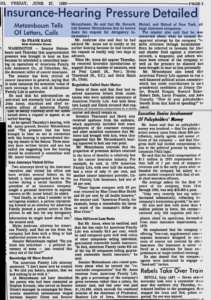
1980 0627 – NP – Toledo Blade – Insurance-Hearing Pressure Detailed – [Howard Metzenbaum] – by Frank Kane
1980 0627 – NP – Toledo Blade – Insurance-Hearing Pressure Detailed – [Howard Metzenbaum] – by Frank Kane
- 1980 0627 – NP – Toledo Blade – Insurance-Hearing Pressure Detailed – [Howard Metzenbaum], by Frank Kane — [BonkNote] — [link-GoogleNews]
-
The Senator also said that he was concerned about what he termed the apparent attempt by the company to stifle criticism through intimidation.
-
Here be referred to lawsuits for libel and slander filed against a television network, a magazine. and others who have been critical of the company well as the pressure he claimed he’d been brought to bear on him personally.
-
-
“And finally. in what I consider to be outrageous conduct. a person representing himself as an attorney for American Family phoned a person active in Ohio politics to ask him for any derogatory information he might know about me,” the senator said.
-
Myles Ambrose, attorney for American Family. said that no one from the company had done such a thing or had authorized anyone to do so.
-
Senator Metzenbaum replied: “Do you think this individual – a political adversary of mine – just created this story out of the blue?”
-
1990 0930 – NYT – Stubbing a Toe on Primerica, By Diana B. Henriques
1990 0930 - NYT - Stubbing a Toe on Primerica, By Diana B. Henriques
- 1990 0930 - NYT - Stubbing a Toe on Primerica, By Diana B. Henriques --- [BonkNote] --- [Link]
The markets are clearly of two minds about the Primerica Corporation, the financial conglomerate that owns Smith Barney, Harris Upham & Company, the Commercial Credit Company and the A. L. Williams insurance operation.
The stock market, to judge by the drubbing the company's shares have taken in the past two months, thinks that Primerica is a poor bet, in part because of emerging problems at the A. L. Williams unit. The bond market's opinion, expressed last week when Commercial Credit sold $100 million in three-year notes, is that Commercial Credit - the bedrock on which Primerica is built - is only slightly less creditworthy than Uncle Sam himself. The odds are, the bond market goofed. The corporate bond market typically classifies borrowers by how much more they pay to borrow than the United States Treasury pays. The gap is measured in basis points, or hundredths of a percentage point. Thus, traders speak of a bond as being priced to yield, say, 150 basis points over Treasuries - that is, 1.5 percentage points more than the Treasury bond yield for the same maturity. Of course, if the borrower offers some sort of collateral, its borrowing costs are likely to be closer to the Treasury rates than if it does not.
Last Monday, the day the Commercial Credit notes were priced, Norwest Bank sold an issue of three-year secured notes, carrying a glittering triple-A by both Moody's and Standard & Poor's. Norwest's interest rate was 75 basis points over Treasury's.
Commercial Credit has a single-A rating from Standard & Poor's. As for collateral, it offered nothing but its good name.
So how did Commercial Credit fare? Remarkably well. The company paid just 78 basis points over three-year Treasury notes. In other words, the bond market was willing to lend money to Commercial Credit, despite a lower rating and the lack of collateral, for only three basis points more in interest than it was getting from a secured, triple-A borrower like Norwest.
Firoz Tarapore, assistant treasurer of both Primerica and Commercial Credit, said the company was the beneficiary of ''fortunate timing,'' selling the notes early in the week, before unrest in the Middle East caused spreads in the bond market to widen. As for the rate, he deemed it to be ''right in with the pack'' of similar issues.
Myron Picoult, an analyst with Oppenheimer & Company, may not be an expert on corporate bond spreads but he has made a thorough study of Primerica for his stock-market clients. On the question of whether one should invest in the company these days, his advice is succinct: don't.
''The stock has clearly broken down, and investor confidence has been shaken,'' he said. ''We would continue to avoid the stock and believe that there is still some downside risk.''
⇒ One thing that worries Mr. Picoult is the unfolding drama at Williams, which Primerica purchased in 1988 from its controversial founder and self-styled ''coach,'' Art Williams. For years, Mr. Williams's aggressive selling style has made him a hero to his 190,000 agents and a thorn in the flesh of his industry rivals. After the Primerica buyout, he stayed on as a sales consultant and de facto leader of the insurance operation, which produces almost a quarter of Primerica's profits.
⇒ Primerica's fans among Wall Street analysts say the A. L. Williams issue is an ''aberration'' and ''an irrelevancy.'' But Mr. Picoult points out that Primerica's promising plan to use Mr. Williams's aggressive disciples to sell the products and services of other subsidiaries, including Commercial Credit, could be derailed by the current turmoil.
⇒ Moreover, he said, ''one wonders whether the United States Attorney's investigation could lead to review of the A. L. Williams operation in other jurisdictions by various state insurance departments, given past complaints about the company.''
Commercial Credit's own market niche is hardly worry-free these days. Of its $4.7 billion portfolio of loans, about 45 percent is secured by real estate - not as much of a comfort as it was before real estate prices started to soften.
Another 45 percent of its portfolio consists of unsecured loans to consumers. And how's that business? Andrew Silver, a senior analyst and economist at Moody's Investors Service, warned in a report last week that the borrowing binge of the 1980's has seriously eroded the consumer's creditworthiness.
It is possible, though unlikely, that both the stock market and the bond market are correct about Primerica - that Commercial Credit can somehow remain a rock-solid borrower throughout the pending business slump, while its parent company nevertheless confirms the stock market's worst fears. It is also possible that the stock market is wrongly punishing Primerica for the A. L. Williams affair, and that the bond market was right to ascribe so little risk to those Commercial Credit notes.
But, possibilities aside, it is certain that Commercial Credit is in the business of lending money to real estate buyers and consumers. It is equally certain that the nation's real estate sector is ailing and it is becoming harder for consumers to pay their debts.
All of which suggests a final possibility: That when bond market investors take a closer look at how little they are being paid to lend money to the Commercial Credit unit of Primerica, a lot of them will wish they had listened to the stock market.