Premium
Guideline Premium
Guideline Premium
- Guideline Premium Forceouts
- 1987 – Federal Register – Volume 52, Issues 62-67, p11201 – Guideline Premium
- Technical Corrections Act of 1988 – Hearing Before the Committee on Finance, United States Senate, One Hundredth Congress, Second Session, on S. 2238 and H.R. 4333, July 13, 1988 · Volume 4
COI – Cost of Insurance
COI – Cost of Insurance
- 2019 0917 – LIIIWG – Life Insurance Illustrations Issues Working Group – (A) – NAIC – COI – Cost of Insurance — [BonkNote]
- 2019 – ACLI – Cost of Insurance in the News – 16p
- Vogt v State Farm – 2017/12/13 – Mrs Vogt Deposition

- Until the buyer understands how the product works, attempts to compare price are essentially meaningless.
1972 – SOA – Life Insurance and the Buyer by Anna Rappaport, Society of Actuaries – 2p-Article
- Maybe we can jiggle a bit with our cost of insurance rates.
— MichaeI R. Tuohy, [Bonk: Tillinghast]
1985 – SOA – Variable Life Insurance in Canada and the United States, rsa85n11n36 – Society of Actuaries – 24p
- The advisory committee requested that if the time value of money is shown, they would like the cost of insurance to be disclosed to the consumer as well.
1991-1A, NAIC – Life Marketing Practices to Senior Citizens Working Group
We then developed a risk cost for the term portion of the universal life insurance product.
— William Arndt
1985 – SOA – Actuarial Pricing Assumptions in a Volatile Environment, Society of Actuaries – 32p
- 19. When I recommend Paragon or Provider, I inform my clients in some form of words that the policies charge a cost of insurance that will increase as they grow older.
- I tell them that the policies maintain cash values, in part to offset that increasing Cost of Insurance.
— Declaration of Sean L. Covi (Agent), 10.09198-JVS(RNBx)
Joyce Walker et al v. Life Insurance Company of the Southwest (LSW) –
- 2013 – LC – US Bank National Association v. PHL Variable Insurance Company
- Dist. Court, SD New York, 2013 – [link-Google Scholar]
- The relevant policies are universal life insurance policies which allow policyholders to pay as much money as they want into their policy accounts each month as long as the account balance is sufficient to cover policy charges, including a “cost of insurance charge …
- State Georgia Tabular Cost of Insurance means the net single premium at the beginning of a policy year for one-year term insurance in the amount of the guaranteed death benefit in that policy year.
ilga.gov/jcar/admincode/050/050014090000300R.html
- Commissioner Lyons reported that the working group feels strongly that the disclosure form should recognize the time value of money.
- The advisory committee requested that if the time value of money is shown, they would like the cost of insurance to be disclosed to the consumer as well.
1991-1A, NAIC Proceedings – Life Marketing Practices to Senior Citizens Working Group
- Ironically, all the columns, figures, pages, disclaimers, and disclosures do not tell consumers what they really want to know -What does the insurance cost?
- Below are my suggestions for what an illustration should tell a consumer.
— J. Robert Hunter, Commissioner of Insurance, Texas Department of Insurance
1994-2, NAIC Proceedings – (Life Disclosure Working Group – NAIC)
- SOA – Agent – I didn’t know Costs Came Out
- 1870 – Book – Cost of Insurance: A Treatise Upon the Cost of Life Insurance, Together with an Arithmetical Explanation of the Computation of Premiums and Valuation of Policies to which are Added Tables of Net Premiums, Cost of Insurance for the Use of Life Insurance Agents, by Nathan Willey
Nonguaranteed Premium
Nonguaranteed Premium (Policy)
- 3. What considerations (including state requirements) are involved in setting the premium rates?
- a. At issue-maximum and illustrated premiums.
1980 – SOA – Nonparticipating Life Products with Nonguaranteed Premiums (rsa80v6n22), Society of Actuaries – 18p
- Nonguaranteed Premium Policies
- Cash values and death benefits under these policies are guaranteed, but their premiums are not.
- These policies contain a guaranteed “maximum premium”, but the company anticipates charging a lower premium.
- The company will illustrate the cost based on the premium it currently expects to charge.
- Your actual cost will be lower or higher than this, depending on the premiums you are actually charged. (p151)
1981 – Academy Journal – Statement 1981-12 – Exhibit C – Possible Changes In Some Sections Of The Life Insurance Buyer’s Guide
- In viewing old Transactions, it appears that the concept was first used by Occidental in the early 1960’s.
- A non-guaranteed premium policy was also introduced in 1972 by Crown Life.
- However, this type of policy did not receive a great deal of attention until 1979, when Aetna Life introduced their Aeconomaster policy.
- Because of an extensive filing effort, Aetna was successful in obtaining approval in almost every state for this policy form. Within the past year, a large number of stock life insurance companies have developed similar products.
- The products introduced by Crown and Aetna were whole life plans.
- More recently, companies have been utilizing the concept for all forms of nonpar insurance, both permanent and term. New ratebooks have been developed with all or most of the products being non-guaranteed premium plans.
- Concept
- The non-guaranteed premium concept is not complicated. Non-guaranteed premium life insurance products are very similar to traditional nonparticipating plans.
- The major difference involves the ability of a life insurance company to change premium rates in the future.
— Richard A. Swift
1980 – SOA – Nonparticipating Life Products with Nonguaranteed Premiums (rsa80v6n22), Society of Actuaries – 18p
- Non-guaranteed Premium
- On the other hand, at Transamerica Life Insurance and Annuity Company, our pension affiliate, the current premiums are priced using a level interest assumption, rather than the more normal assumptions that interest rates will decline. [Bonk: grading]
- For most of the products on the market, the current premiums are guaranteed not to be raised for a period of any where from one to six years from issue.
- During this period when the current premiums are guaranteed, deficiency reserves would have to be set up based on the current premiums.
— Denise F. Roeder, Occidental, Transamerica
1980 – SOA – Nonparticipating Life Products with Nonguaranteed Premiums (rsa80v6n22), Society of Actuaries – 18p
- During 1984, under pressure from the Securities and Exchange Commission (SEC), the Non-Guaranteed Premium Products Task Force of the American Institute of Certified Public Accountants (AICPA) Insurance Companies Committee produced an issues paper with the succinct title of
- “Accounting by Stock Life Insurance Companies for Annuities, Universal Life Insurance and Related Products and Accounting For Non-Guaranteed Premium Contracts.” – 120p
1985 – SOA – New Product Accounting Alternatives, Society of Actuaries – 26p
Insufficient Premium
Insufficient Premiums
- Premium Considerations
- The non-guaranteed premium concept can be utilized for all forms of nonparticipating insurance, including both term and permanent policies.
- In setting insurance premiums, the actuary can use pricing assumptions that are as realistic as possible.
- The actuary is not locked into “50 years” of insufficient premiums if his or her estimates of future assumptions prove to be too optimistic.
— Richard A. Swift – [Bonk: Aetna-?]
1980 – SOA – Nonparticipating Life Products with Nonguaranteed Premiums (rsa80v6n22), Society of Actuaries – 18p
In a low-priced office the climax will be arrived at in about 17 years, after which period there will be a deficiency, and the ruinous effects of too low a rate of premiums will become apparent to the public generally.
1850 – Book – Practical Remarks on the Present State of Life Insurance in the United States: Showing the Evils which Exist, and Rules for Improvement, by Harvey G.Tuckett
- This paper analyzes the situation which would arise in a system which provided benefits based on life contingencies and where all participants paid insufficient premiums.
- We define an insufficient premium as any premium less than the sufficient premium, and the sufficient premium as the one computed by the usual actuarial methods so as to equate the present value of the premiums to be paid by an individual to the present value of the benefits he is to receive, as of the date he enters the system.
- Of course no private insurer would charge insufficient premiums even if it were legal to do so.
— Paul W. Nowlin
1959 – SOA – Insufficient Premiums, Society of Actuaries – 12p
Premium Loan
Premium Loan
- APL – Automatic Premium Loan
- Premium Loan
- Sales Strategies
- Automatic premium loan
- A loan provision in a life insurance policy allowing any premium not paid by the end of the grace period (usually 30 or 31 days) to be paid automatically through a policy loan if cash value is sufficient. (p134)
2016 – ACLI Fact Book – 186p
- J. B. WALKER felt that an APL clause provides the policyholder with two advantages over extended insurance: the opportunity to resume payment of premiums without furnishing evidence of insurability, and the continuation of disability, double indemnity and family income benefits.
1950 – SOA – General, tsa50v2n327 – Society of Actuaries – 5p
- SUMMARY CONCLUSION:
- 3. A policy (or contract) loan shall be defined as a loan to a policyholder, under the provisions of an insurance contract, that is secured by the cash surrender value of the related policy or contract. Policy loans shall include:
- Cash loans including loans resulting from early payment benefits or accelerated payment benefits on contracts when the terms of the contract specify that such payments are policy loans secured by the policy and interest is charged.
- Automatic premium loans, which are loans made in accordance with policy provisions whereby delinquent premium payments are automatically paid from the cash value at the end of the established grace period for premium payments.
- Automatic Premium Loans
- An automatic premium loan (APL) is one which is made in accordance with the provision in some policies for automatically paying a delinquent premium from the cash value at the end of the grace period.
- A special loan agreement is not required because the policy owner previously requested the APL option.
- In some states the policy owner must specifically elect this provision for it to be effective.
- The purpose of the APL provision is that, in the event of inadvertent nonpayment of premium or temporary inability to pay the premium, the policy is kept in full force.
- If the policy were allowed to lapse and the nonforfeiture options of reduced paid-up or extended term insurance were effective, the policy owner would then be required to comply with the reinstatement procedures, such as furnishing evidence of insurability.
- Generally Accepted Accounting Principles
- 14. The AICPA Audit and Accounting Guide: Stock Life Insurance Companies provides the following guidance in Chapter 4, Investment Operations: Policy Loans*
- 4.13 Life insurance companies generally must permit borrowing against the cash values of policies. Policy loans are carried at their unpaid balances including accumulated interest but not in excess of cash surrender values or in excess of policy reserves.
- Many policy contracts require the company to initiate an “automatic premium loan” to pay delinquent premiums.
1996-1, NAIC Proceedings
Single Premium Life Insurance
Single Premium Life Insurance
- SPL – Single Premium Life
- SPWL – Single Premium Whole Life
- 1988 0315 – GOV (House) – Investment Uses of Life Insurance, Charles Rangel (D-NY)
- [PDF-257p-GooglePlay, VIDEO-?]
- 1988 0325 – GOV (Senate) – Tax Treatment of Single-Premium Life Insurance, Max Baucus (D-MT) — [BonkNote]
- LIRP – Life Insurance Retirement Plan
- In the early years of Single Premium Life (endowments), producers sold the heck out of them.
- It took a while before the feds figured out they were being used as tax-shelters.
- That epiphany led to the resurrection of the decades old debate about taxing the inside build-up in a life insurance contract, a war NAIFA has been fighting since 1913.
- And won every battle.
2017 0803 – NAIFA-Washington – IFAPAC and MEC, by Richard Ek, NAIFA member since 1975 – [link]
- The tax law wounded single premium whole life (notice that I didn’t say killed it), and has moved many away from the single premium life business.
— Timothy C. Pfeifer
1990 – SOA – Life Product Development Update, rsa90v16n36 – Society of Actuaries – 38p
- 1999 – LC – Greenberg v. Life Ins. Co. of Virginia – [GoogleScholar]
- re: Single Premium Life Insurance Policy
- 177 F. 3d 507 – Court of Appeals, 6th Circuit
- Under this second theory, Greenberg and Rossmann contend that Life of Virginia’s agent, using misleading policy illustrations, falsely represented to them that no further premium payments would be required for their policies beyond the single initial premium payment …
- 1970s / 1980s – NAIC Proceedings
- Special Plans
- Valuation / Nonforfeiture
- UAONP Task Force – UNIVERSAL AND OTHER NEW PLANS (A) TASK FORCE
- 1986-2, NAIC Proceedings
- p585 – Single Premium Life Insurance Concerns (Attachment One-F)
- 1987-1, NAIC Proceedings
- 1986 1208 – p46 – 2. Adopted recommendations to delete modified guaranteed life insurance plans project from the task force agenda and reprioritize single premium life topic to number one category.
- p510 – 4j. Single Premium Life Concerns – This proposed project concerns various questions regarding reserves and nonforfeiture values for single premium whole life insurance plans. One of these questions would involve proper reserves for such plans which contain bailout provisions. For such plans, a guideline analogous to that concerning annuities with a bail-out provision is needed.
- 1988-2, NAIC Proceedings
- p410 – Letter – from Douglas C. Doll, Chairman, Universal Life Task Force – Paid-Up Option – In our June 1987 report, we waffled on whether a paid-up option should be required on flexible premium products. As mentioned earlier, there are technical arguments that none is required because premium default does not occur. However, the intent of the SNFL appears to require it. We are not opposed to the paid-up option requirement. We do have several comments and questions, as follows:
- Would single premium life be affected?
- p410 – Letter – from Douglas C. Doll, Chairman, Universal Life Task Force – Paid-Up Option – In our June 1987 report, we waffled on whether a paid-up option should be required on flexible premium products. As mentioned earlier, there are technical arguments that none is required because premium default does not occur. However, the intent of the SNFL appears to require it. We are not opposed to the paid-up option requirement. We do have several comments and questions, as follows:
- 1988-2, NAIC Proceedings
- p465 – d. Study issues involving reserves and nonforfeiture values of single premium life insurance.
- It was indicated that the Life and Health Actuarial Task Force has made no progress on this particular item.
- John Montgomery (CA) – commented that this is a new product which is being affected by recent actions of the Internal Revenue Service and Congress in taxing the inside build-up.
- Discussion followed on other new products/consumer concerns. Corporate-owned leveraged life insurance was identified as a serious concern. A corporation issues a policy on an individual with the corporation as owner of the policy and benefits payable to the corporation. The policy is used as funding mechanism for post retirement benefits for employees and may be issued on either a group or individual basis. The policies may or may not be issued on a “key man” basis. The premiums are large premiums because they are funding an ordinary life policy. The money flows into the company and tax advantages are made of the inside build-up. Questions arise as to whose benefit the policy is purchased and whether a group deposit should be made by those administering the fund. Mr. Montgomery indicated that these questions may be legal questions. The Actuarial Task Force indicated that it would charge someone to address this issue and will report at the Universal and Other New Plans Task Force meeting in New York (June 1988).
- Another issue involves setting aside additional reserves for AIDS. The Actuarial Task Force also will be reporting to the Life Insurance (A) Committee on this. The Actuarial Task Force also will report to the Universal Task Force on whole life policies without cash values.
- It was suggested that Actuarial Guideline IV be revised to address the type of policy in which early premiums are so low that they do not support the value of the policy. The problem is that there may be atypical lapses, i.e. not enough people to pay the more expensive premium to support the benefits.
- Another item concerning certain life insurance plans with increasing death benefits was identified as a potential problem. It was noted that Michigan has unlimited death benefit increases which are related to the consumer price index which applies to single premium life policies. Ted Becker suggested that the Task Force consider assigning this issue to the Actuarial Task Force.
- It was indicated that the Life and Health Actuarial Task Force has made no progress on this particular item.
- p465 – d. Study issues involving reserves and nonforfeiture values of single premium life insurance.
- 1989-1, NAIC Proceedings
- Priority 1 Projects – Life Insurance (A) Committee
- 4j Special Plans – Single Premium Life Insurance Concerns (PD Task Force) (On hold)
- Priority 1 Projects – Life Insurance (A) Committee
- 1990-1A, NAIC Proceedings
- p451 – 3. Report of Life and Health Actuarial (Technical) Task Force
- John Montgomery (Calif.) presented the report of the task force and highlighted work they are currently undertaking in the following areas:
- 3) Project 4j “Single Premium Life Insurance Concerns.” Because of limited interest in this area, the Actuarial Task Force is recommending that this item be removed from its agenda.
- John Montgomery (Calif.) presented the report of the task force and highlighted work they are currently undertaking in the following areas:
- p451 – 3. Report of Life and Health Actuarial (Technical) Task Force
- 2012 – LC – BERNICE F. BAMBULIS vs. PROTECTIVE LIFE INSURANCE CO.
- Civil Action No. 11-2256
- United States District Court, E.D. Louisiana.
- 2012 1211 – [Google Scholar]
- This action arose over the termination of a life insurance policy and an alleged misunderstanding over the tax consequences of that closure.
- On June 20, 1988, Kemper Investors Life Insurance Company (“Kemper”) issued a single-premium life insurance policy to Bambulis. (Rec. Doc. No. 26-1, at 1).
- Along with the Surrender Form, Plaintiff enclosed a letter to Kemper, indicating her belief that no tax should be owed for the surrender of the Policy because the Policy was purchased with the proceeds of a 401(k).
- Accordingly, for the reasons stated above, IT IS ORDERED that Defendant’s Motion for Summary Judgment (Rec. Doc. No. 26) be GRANTED.
- The life insurance industry scored a major victory over House Ways and Means Committee Chairman Dan Rostenkowski (D-Ill.) yesterday as the committee rejected his proposal to sharply cut back one of the few remaining shelters in the federal tax code.
- Rostenkowski had called for removing the chief tax advantage now available to investors in so-called single-premium life insurance policies, which have been heavily touted by the industry as tax-reduction mechanisms.
- The cutback the committee adopted still goes further than the industry had hoped, but Rostenkowski and other critics of the policies expressed concern that abuses would continue nonetheless.
- Before the vote, Rostenkowski called the single-premium policies “an affront to the 1986 act,” which removed many tax benefits from the tax code, and “an abuse that must be corrected.”
1988 0630 – The Washington Post – Rostenkowski Loses Bid To Get Insurance Tax, by Albert B. Crenshaw – [link]
- 1985 – SOA – Single Premium Deferred Annuities and Single Premium Whole Life Products, rsa85v11n4a9 – Society of Actuaries – 24p
- 1987 10 – GAO – Taxation of Single Premium Life Insurance – Briefing Report to the Honorable Fortney H. (Pete) Stark (D-CA), House of Representatives – 38p
- 1987 – SOA – Methods of Underwriting and Considerations In Pricing, rsa87v13n212 – Society of Actuaries – 40p
- 1987 – SOA – Single-Premium Whole Life Insurance (SPWL), by Gary E. Dahlman, act-1987-vol21-iss09-huntington – Society of Actuaries – 3p
- 1987 – SOA – Single Premium Life and Annuity Products, rsa87v13n4b4 – Society of Actuaries – 22p
-
1988 0315 – GAO – Testimony – Taxation of Single Premium Life Insurance, General Accounting Office – 15p
- govinfo.gov/app/details/CFR-2020-title26-vol4/CFR-2020-title26-vol4-sec1-264-2/context
- 1988 0315 – JCT – Background and Issues Relating to the Tax Treatment of Single Premium and Other Investment-Oriented Life Insurance, jcs-6-88-3245 – 42p
-
1988 0315 – GAO – Testimony – Taxation of Single Premium Life Insurance – 15p
- 1988 0325 – GOV (Senate) – Tax Treatment of Single-Premium Life Insurance, (CSPAN) Single Premium Life Insurance, Max Baucus, (D-MT) — [BonkNote]
- 1993 – SOA – The Valuation Actuary – An Overview of 1993 Developments – PRACTICE NOTE 1993-4 – vasp931 – 146p
- Q: What approaches to modeling interest rates are included in current actuarial practice?
A: Approaches currently used to represent interest rates in actuarial models may be broadly categorized as deterministic and stochastic. The most familiar deterministic approach is a single interest rate model, in which projections are made and present values are calculated using a single interest rate. A slight generalization of this approach is the single scenario method, in which a series of interest rates are used for future years, such as one rate for 15 years and another rate thereafter. A second deterministic approach is the multiple fixed scenario method. In this approach, several scenarios (series of future interest rates) are used. An example of this approach is the “New York Seven” scenarios, which are required for filings under New York Regulation 126. These are also the basic seven scenarios stated in the NAIC Model Actuarial Opinion and Memorandum Regulation (the Model Regulation). The multiple fixed scenario method can be further generalized by constructing yield curve scenarios (series of future yield
curves). - Stochastic methods generally fall into two categories: random scenario models and option pricing models.
- Q: What approaches to modeling interest rates are included in current actuarial practice?
- (p151) – Written Statement of the Connecticut Mutual Life Insurance Company
- Single premium sales grew from 1984 through 1987 from just over $1 billion of premium to just under $10 billion, approximately doubling the sales for each preceding year.
- More astounding, perhaps, is the fact that single premium sales from a small fraction of new premium for all forms of insurance to virtually rival sales of all other forms of insurance combined – which approximated $10 billion in 1987.
- More important, perhaps, are the facts cited in the GAO testimony indicating that more than half of single premium sales during 1986 were attributable to stockbrokers.
- Single premium sales grew from 1984 through 1987 from just over $1 billion of premium to just under $10 billion, approximately doubling the sales for each preceding year.
1988 0325 – GOV (Senate) – Tax Treatment of Single-Premium Life Insurance, (CSPAN) Single Premium Life Insurance, Max Baucus, (D-MT) — [BonkNote]
- The SPI product may be marketed as a superior, hybrid SPDA: “an investment grade single premium product,” according to one brochure. Alternatively, the SPI may be sold with high premiums as an estate planning vehicle for the wealthy individual.
- Currently, this second alternative would be unusual, but agents may find such a market niche at the expense of the insurer with casual underwriting.
- The wealthy individual who is slightly substandard would be an ideal prospect from the agent perspective.
1985 – SOA – Single Premium Deferred Annuities and Single Premium Whole Life Products, Society of Actuaries – 24p
- Another old but little-used product is making a comeback.
- Single premium whole life insurance (SPWL) with minimal death benefits and current market interest credits is being sold in considerable volume, particularly in the securities brokerage market.
- Many general agency and brokerage life insurers have also introduced SPWL products recently.
- SPWL sales have accelerated rapidly since the passage of the Tax Reform Act of 1986.
- While the Tax Act eliminated or significantly reduced the attractiveness of many past popular tax shelters, life insurance was left relatively untouched.
1987 – SOA – Single-Premium Whole Life Insurance (SPWL), by Gary E. Dahlman, Society of Actuaries – 3p
- Michael WINTERFIELD: I will take one shot at the change in the marketing of the product. I think the majority of individuals who are buying single premium life insurance are interested at some point in time in exercising the distribution right — and having some potential to get them tax-free is very important. I think we are looking at loan rates which will increase very much over time. Most of us haven’t seen particularly high loan rates in the first 2-3 years. Many people who are buying are looking forward to taking loans out after 5-10 years, 15 years, or whenever they reach a retirement age.
- With that in mind, I think the distribution side is tightened up. I would see many people not purchasing single premium life insurance, but probably in many of these cases switching over to an SPDA, which would still be perceived as having some advantage. I would agree with comments that Paul had made earlier in that area.
- Paul LEFEVRE: We feel maybe about 20% of our single premium whole life customers are buying the product with the express idea that they are going to take annual loan distributions or take advantage of the so-called “take your income out tax-free-type approach.”
- The question that alludes to what you are saying is, in addition to those people, how many people find the product attractive because they know they can get at their money? I don’t know what that is.
1987 – SOA – Single Premium Life and Annuity Products, Society of Actuaries – 22p
- HAROLD G. INGRAHAM JR.: There’s been no shortage of proposals pending before Congress about the investment war and alleged tax avoidance abuses of single premium life insurance products.
- The government wants to raise between $20 billion and $60 billion of new revenue and the life insurance industry is apparently being targeted for about one-third of this budget increase.
- So the issue for the industry is one of damage control at best.
- There’s no question that Congress, on some basis, is going to zap single premium life policies, whether they be single premium whole life, single premium universal life, or single premium variable life.
- They regard these policies as essentially tax shelters supported by small death benefits.
- And the key issue is the relationship of death benefits to cash values which inexorably leads you to reconsider the definitions of life insurance in Section 7702 of the Internal Revenue Code.
- The government wants to raise between $20 billion and $60 billion of new revenue and the life insurance industry is apparently being targeted for about one-third of this budget increase.
1988 – SOA – Current Topics For Individual Life And Annuity Product Development, /rsa88v14n216 – Society of Actuaries – 16p
Product Design And Marketing Under Section 7702A
Product Design And Marketing Under Section 7702A This session discussion is about SPWL: Is … marketing point of view. With respect to single premium whole life (SPWL), we’re seeing sales drop. Premium … View Description- Authors: Application Administrator, Christian J DesRochers, R Richard Retticker
- Date: Oct 1989
- The second change in 1989 was the addition of certain single premium whole life contacts to the scope of Regulation 126 filings. Single premium whole life contracts which are defacto single premium deferred annuities (SPDAs) must be included in the Regulation 126 reserve testing.
— Arthur V. Anderson, consulting actuary with Milliman and Robertson.
1990 – SOA – Tax Cash-Flow Projections, rsa90v16n221 – Society of Actuaries – 22p
- I went to a company that did not want term, but wanted to come up with single-premium whole life. And this was before the tax law made the product less competitive than annuities. Prior to TEFRA, single-premium whole life had no limit as to how low the face amount could be. At that time, the single-premium whole life was much more tax efficient than annuities or any other investment product, Sales went from $3 to $100 million in a year, But the paperwork was not overwhelming. The increase in staff was minimal. There was a strain on the staff, but apparently we all understood the nature of term, which accounts for underwriting time and a tremendous amount of paperwork. There was much less work associated with investment products. Let’s step back for a minute and try and analyze what has happened.
- Like all case studies, there are principles to be learned. The following are several principles that I have learned. Principle number one, if a company wants its sales to go to the roof, hire me, Larry Silkes.
— Larry Silkes, is a consulting actuary with Mercer. He’s been chief actuary at William Penn and senior vice president and product actuary at National Benefit
1991 – SOA – Expense Strategy and Pricing Considerations, rsa91v17n13 – Society of Actuaries – 18p
- We have a bank client in Texas that is a good model for us. We have put through 35 investment counselors, and they’re selling a single-premium whole life product, an annuity look-alike product, a replacement for the chronic annuity buyer who’s been wandering in and out of the branch for years, who is being sold fixed annuities. We have now just recently hired about four insurance specialists to pyramid on top of that. Our investment counselors are all very comfortable selling that product, and that bank will sell quite a bit of that product for us this year. Now they are more comfortable with understanding and identifying a need, recognizing a long-term-care opportunity, recognizing a permanent insurance opportunity, and so we’ve seen a nice migration there. The challenge is to be patient enough to integrate with existing distribution channels; we think that’s key. Obviously, I’ve said before that I think the focus is really on packaging, as opposed to features
— John K. Hillman, not a member of the sponsoring organizations, is President of Philadelphia Financial Group in Blue Bell, PA
1997 – SOA – Bank Alliance Niche for Insurers, rsa97v23n379pd – Society of Actuaries – 22p
Premium Due Date
Premium Due Date
- …this was done because (1) the concept of a “premium due date” was thought to be inapposite to flexible premium policies.
1983-1, NAIC proceedings
def. inapposite: out of place; inappropriate
- [Lawsuits]
- 2018 – LC – Elhouty v Lincoln Benefit, United States Court of Appeals, Ninth Circuit, Google Scholar
- 2010 – LC – Maloof v. John Hancock, Alabama Supreme Court — [BonkNote]
- 2013 – LC – Johnson and Johnson v. Conseco
- 2013 0312 – ACLI – Amicus Brief – Johnston and Johnston v Conseco – 24-1/2 – 13-30010 – 54p
- 24-1 – (p11) – A. Because of the unique nature of flexible premium policies, they do not have traditional dates when premiums are “due,” making it difficult to calculate notice provisions keyed off when premiums are “due.”
Scheduled Premium
Scheduled Premium
- Section 15. Schedule Premium Policy.
- The definition of a “scheduled premium policy” was added by the 1983 amendments to the Model Regulation.
- It is intended and to establish the perimeters of contemporary “traditional” variable life insurance policies.
- Specifically, a variable life insurance policy is classified as a “scheduled premium” policy if the insurer has established (or “fixed”) both:
- the amount of required premium payments and the times at which they are to be paid.
- Typically, under a scheduled premium policy, if a premium is not paid in accordance with the “schedule” which has been “fixed” by the insurer, and if the non-payment of premium is not remedied within the applicable grace period, the policy lapses, triggering the operation of non-forfeiture options.
- ⇒ It should be noted that a policy would not necessarily be classified as a “scheduled premium” policy simply because the specifications page might set forth a “planned premium” (a concept characteristic of current universal life insurance policies).
- This is because the planned premium, in most cases, is set by the insured, not the insurer.
1983-2, NAIC Proceedings
Vanishing Premium
Vanishing Premium
- Vanishing Premium – Lawsuits
- 1997 – SOA – Vanishing Premium Illustrations Revisited, by Arnold F. Shapiro, arch97v121 – Society of Actuaries – 10p
- 1997 – LR – The Law and Economics of Vanishing Premium Life Insurance, 22 Del. J. Corp. L. 1, 22, 30-31, by Daniel R. Fishchel & Robert S. Stillman – 37p
- Two weeks ago in the National Underwriter, there was a report of the working group’s meeting in Philadelphia, and on the same page was a writeup about an agent who had won a very large amount of money from his company.
- Apparently, he never understood about “vanish” illustrations and got into trouble with his clients.”
- I found it fascinating that the agent in the Crown Life case got $40 million for mental anguish.
- [Bonk: Agent = William Casteel]
- [Bonk: Vanishing Premium] /// Vanishing Premium – Lawsuits]
- <WishList> – National Underwriter Article
— Kevin A. Marti, vice president of administration and chief actuary for Westfield Life Insurance Company
1995 – SOA – Sales Illustrations, Society of Actuaries – 14p
- [Vanishing Premium]
- James D. ATKINS: The NAIC has proposed a life insurance illustration regulation. The draft I have is dated April 21, that’s fairly recent. I hope you’ve had a chance to look it over.
- I’d like to start out by posing a question and that is, what is the impetus behind introducing this illustration regulation?
- Why are we doing this?
- I’d like to start out by posing a question and that is, what is the impetus behind introducing this illustration regulation?
- Robert E. Wilcox, Utah Insurance Commissioner and Chair of the LDWG – Life Disclosure Working Group – (A) – NAIC — [BonkNote]: Efforts began in the NAIC to look at the quality of the illustrations as the investment market turned steeply downhill and premiums that were supposed to vanish didn’t.
- That put tremendous pressure on the companies and on the regulators of the companies to look at this particular issue.
- If you look at last week’s copy of the National Underwriter, there was word of a lawsuit, actually two or three lawsuits, that had been filed over the issue of reappearing or nonvanishing premiums.
- That points out the initial problem.
- Whatever we did to illustrate those contracts when they were sold, the policyholders did not understand the contingent nature of that vanish.
- That’s the underlying reason we got into this.
- James D. ATKINS: You mean just because they didn’t understand the vanishing premium illustration we have all this regulation being imposed?
1995 – SOA – Current Developments Surrounding Regulations and Standards of Life and Annuity Products, Society of Actuaries – 18p
- 1996 0121 – Letter – ATTACHMENT ONE-A1
- TO: NAIC Members
- FROM: — Robert E. Wilcox, Utah Insurance Commissioner and Chair of the LDWG – Life Disclosure Working Group – (A) – NAIC — [BonkNote]
- RE: Life Insurance Illustrations Model Regulation
- In December the NAIC membership adopted a new Life Insurance Illustrations Model Regulation to address some of the problems we have all been experiencing as consumers complain that their “vanishing” premiums haven’t vanished and the high returns they expected haven’t materialized.
1996-1, NAIC Proc.
- [Vanishing Premium]
- Q. Do you recall the vanishing premium litigation?
- A (Wilcox): Very well.
- Q. Would you agree that the sales practices that were used in the vanishing premium — in selling those policies was problematic?
- MR. HIGGINS: Objection. Vague.
- THE WITNESS (Wilcox): In a limited number of cases, that was true. But again, that’s a different question than you asked before.
- Problematic is not the same as unlawful.
- MR. PAUL: Q. Do you not believe that the sales practices used — that were at issue in the vanishing premium issue were unlawful?
- MR. HIGGINS: Objection. Vague.
- THE WITNESS (Wilcox): There may have been a few instances where it was unlawful. In general, it was not vanishing premium issue were unlawful?
MR. HIGGINS: Objection. Vague.
THE WITNESS (Wilcox): There may have been a few instances where it was unlawful. In general, it was not.
2012 0313 – LC – Thao v. Midland National – Document 66-1 – Deposition of Robert E. Wilcox, Former Utah Insurance Commissioner and Chair of the LDWG – Life Disclosure Working Group – (A) – NAIC — [BonkNote] — 9p
- Robert Beck, Prudential, Chairman and Chief Executive Office
- [RE: Vanishing Premium]
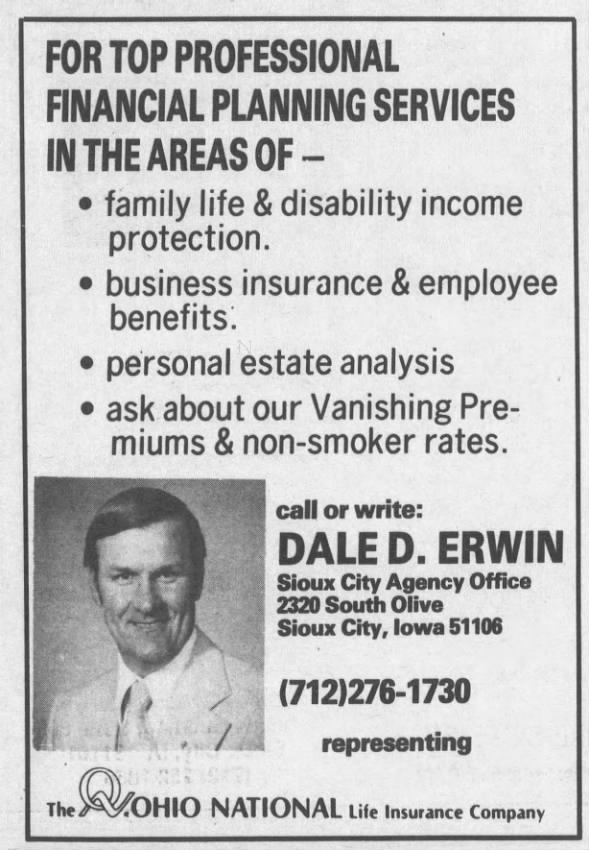
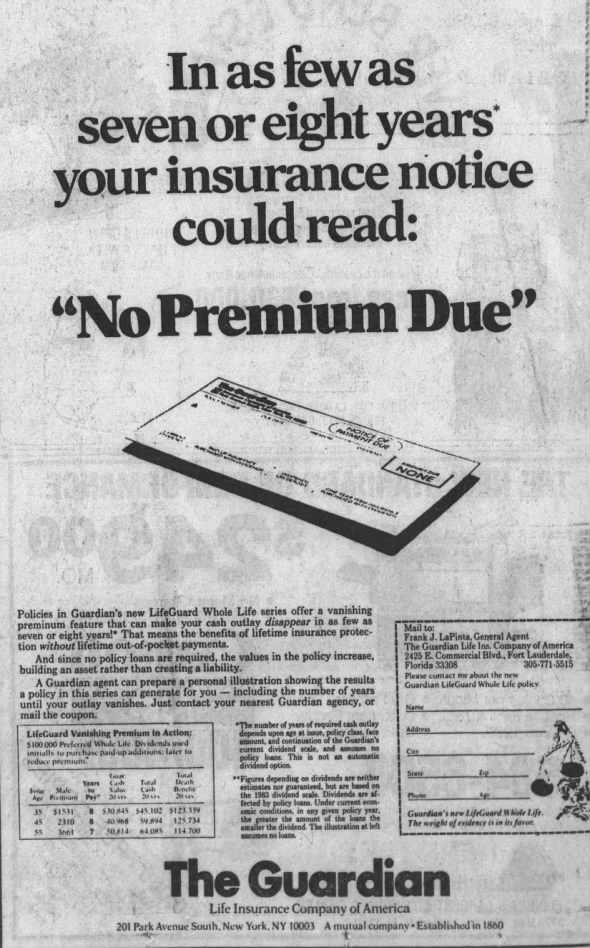
- (p6069) – Under some permanent insurance, contracts being sold today, the chances are you could stop paying after 7, 8, or 9 years and the insurance would remain in force for the rest of your life without further premium payments.
- (at approx. 2:27:00-2:27:30) – [VIDEO-CSPAN] – Impact of Tax Reform on Insurance Industry
1985 0719 Impact of Tax Reform on Insurance Industry, Pete Stark (D-CA) — [BonkNote]
- If I bought a camera down the street and when I got back to my hotel room, the shop owner called me and said, “Oh, by the way, you owe me another $100 for that camera,” I would feel exactly like many of the vanishing premium victims have felt.
- I understand the lawsuit.
- I think we could have avoided the problem through effective reillustration.
— Christopher H. Hause
1995 – SOA – Current Developments Surrounding Regulations and Standards of Life and Annuity Products, Society of Actuaries – 18p
- (p51) – Gregory SERIO. NAIC / Superintendent, New York Department of Insurance – Price is a factor. Price should not be the leading factor on it. It should be a factor. I will go to this issue.
- Just a few years ago, we had this thing called vanishing premiums, where people were given a promise that their premiums were going to go away, and they were going to have this insurance coverage forever or for as long as they were told they were going to have it.
- That did not pan out, because those interest assumptions were wrong, because those other investment income assumptions were wrong over the duration of that policy.
- And we had to go back and rethink how it is that the companies are not only structuring these products but how they are selling them.
- And I think what has been happening is that this notion that the public is going to save money a little bit here, a little bit there is a hard thing to do when you are talking about a product that you need to have guaranteed at the end of the day
- Just a few years ago, we had this thing called vanishing premiums, where people were given a promise that their premiums were going to go away, and they were going to have this insurance coverage forever or for as long as they were told they were going to have it.
- (p68) – J. Robert Hunter (CFA) – Consumers, who over the last 30 years have been the victims of vanishing premiums….
2004 0922 – GOV (Senate) – Examination and Oversight of the Condition and Regulation of the Insurance Industry, Richard Shelby (R-AL) — [BonkNote]
- Equitable Life Insurance was accused of misleading and cheating customers.
- This was a situation of the so-called vanishing premium cases in the 1980s.
- They sold policies when interest rates were high.
- They told customers as soon as the interest rates went down their premiums would be lower.
- That was not true.
- Class action lawsuits were filed in Pennsylvania and Arizona state courts, and Equitable settled the suits for $20 million helping over 130,000 people.
- However, because the insurance company was based in another state, under this legislation, the case would have been removed to federal court and these people harmed between 1984-1996 would still be waiting for justice. (S1150)
— Senator Harry Reid (D-NV)
2005 0209 – Congressional Record – [PDF-70p]
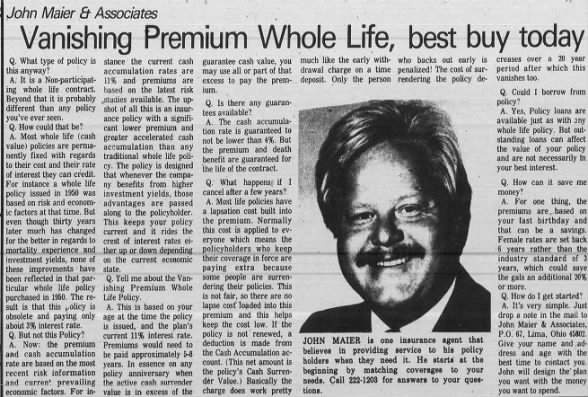
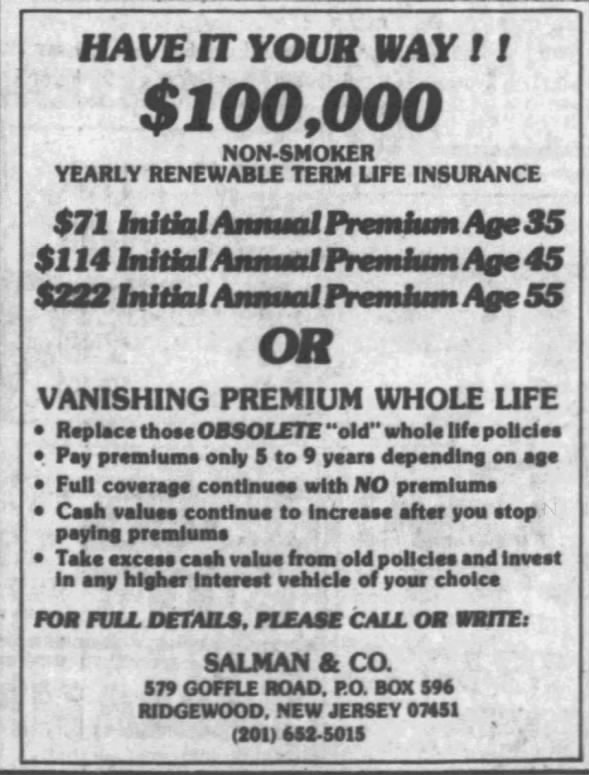
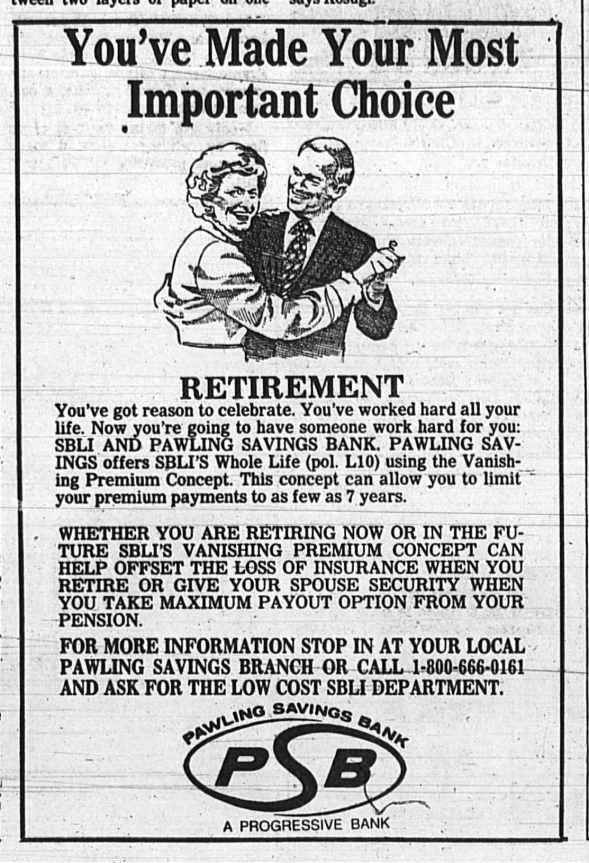
- Vanishing premium whole life is often called irreplaceable life, with a premium almost equivalent to what an old fashioned, whole-life, nonparticipating policy had, but there’s a direct crediting of interest and direct recognition of mortality.
- A policy like that with the current high interest rates could stop premiums after about five to eight years.
— Ralph H. Goebel, Northwestern National Life Insurance through its various name changes. He retired in 1985 – Obituary – [link]
1985 – SOA – New Product Accounting Alternatives, Society of Actuaries – 18p
- 1984 – SOA – Deregulation of Financial Industries (rsa84v10n221), Society of Actuaries – 30p
- 1985 0719 Impact of Tax Reform on Insurance Industry, Pete Stark (D-CA) — [BonkNote]
- 1985 – SOA – New Product Accounting Alternatives, Society of Actuaries – 18p
- 1985 – SOA – United States Life Insurance Tax Law, Society of Actuaries – 58p
- 1994 0613 – apnews – Life Insurance Buyers Allege Misleading Sales Tactics Were Used With PM-Vanishing Premiums-Illustrations, by Mark Dennis – [link]
- 1995 – SOA – Current Developments Surrounding Regulations and Standards of Life and Annuity Products, Society of Actuaries – 18p
- 1995 – SOA – Practical Illustrations and Nonforfeiture Values, Society of Actuaries – 14p
- 1995 – SOA – Sales Illustrations, Society of Actuaries – 14p
- 1996 – SOA – Legal Issues Affecting Nontraditional Products, Society of Actuaries – 14p
- 1997 – SOA – Vanishing Premium Illustrations Revisited, Arnold F. Shapiro, Society of Actuaries – 10p
- 1997 1024 – WSJ – MONY Wins Dismissal of Suit Over ‘Vanishing Premium’ Policies, by Leslie Scism – [link]
- 1997 – LR – The Law and Economics of Vanishing Premium Insurance, by Daniel R. Fischel and Robert S. Stillman – 37p
- 2004 0922 – GOV (Senate) – Examination and Oversight of the Condition and Regulation of the Insurance Industry, Richard Shelby (R-AL) — [BonkNote]
- 2018 03 – NCLC – Consumer Protection in the States: A 50-State Evaluation of Unfair and Deceptive Practices Laws, National Consumer Law Center – 76p
- Thus, we have universal life policies with a so-called low target premium where excess interest earnings can carry the policy for the whole of life with the payment of that low premium.
- We have the other extreme where the premium is higher but through the use of dividends or excess interest earnings, premiums are paid for only a few years. [Bonk: Vanishing Premium]
— John L. Marcus, Prudential
1984 – SOA – Deregulation of Financial Industries (rsa84v10n221), Society of Actuaries – 30p
- Mr. Whittmore: You can illustrate a vanishing premium scenario as a supplemental illustration.
- It has to follow all the same rules as the base illustration, as far as supportability, not being lapse supported and the like, but for some reason they have actually banned the terminology, vanished premium, or anything along those lines.
- W. Keith Sloan: The vanishing-premium concept has been with us since the beginning of the century.
- I’ve seen illustrations of policies in companies that were formed about that time and had things that we sometimes call charter policies, and coupon policies, for example.
- One company I know routinely sold a coupon policy, 20-pay, with the coupons cancelled, which made it a 14-pay.
- That’s a vanishing premium.
- This was brought out, I think, in 1914, so it’s not a new concept…
- ….but I’d like to point out one other real problem, and that’s that most of these illustrations are not made up in the home office–they’re produced on laptops in the field.
- Regardless of how disciplined the scale is that you put into the agent’s laptop, if he can change it or, as in one instance that I have seen, if he is trying to show a loan-supported policy and doesn’t recognize that with a variable loan rate when the interest rate changes on the loan, it’s also going to change on the dividends,
- …somebody is in trouble.
- As a matter of fact, somebody was in trouble and they lost a lawsuit on that.
- [Bonk: 199x – LC – Ferguson v. Crown Life / Casteel – 91-11537 – ?]
- Regardless of how disciplined the scale is that you put into the agent’s laptop, if he can change it or, as in one instance that I have seen, if he is trying to show a loan-supported policy and doesn’t recognize that with a variable loan rate when the interest rate changes on the loan, it’s also going to change on the dividends,
1995 – SOA – Practical Illustrations and Nonforfeiture Values, Society of Actuaries – 14p
- (p20) – Coverage of insurance
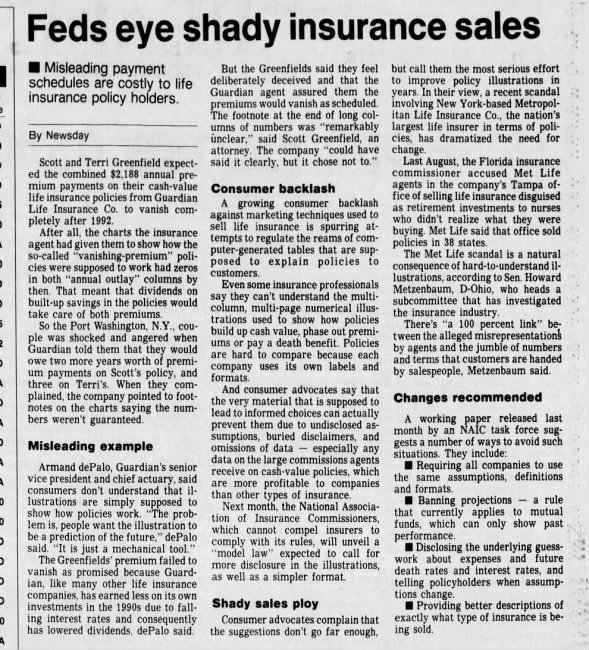
- Insurance policies are complicated financial instruments, making it difficult for consumers to detect deceptive sales pitches.
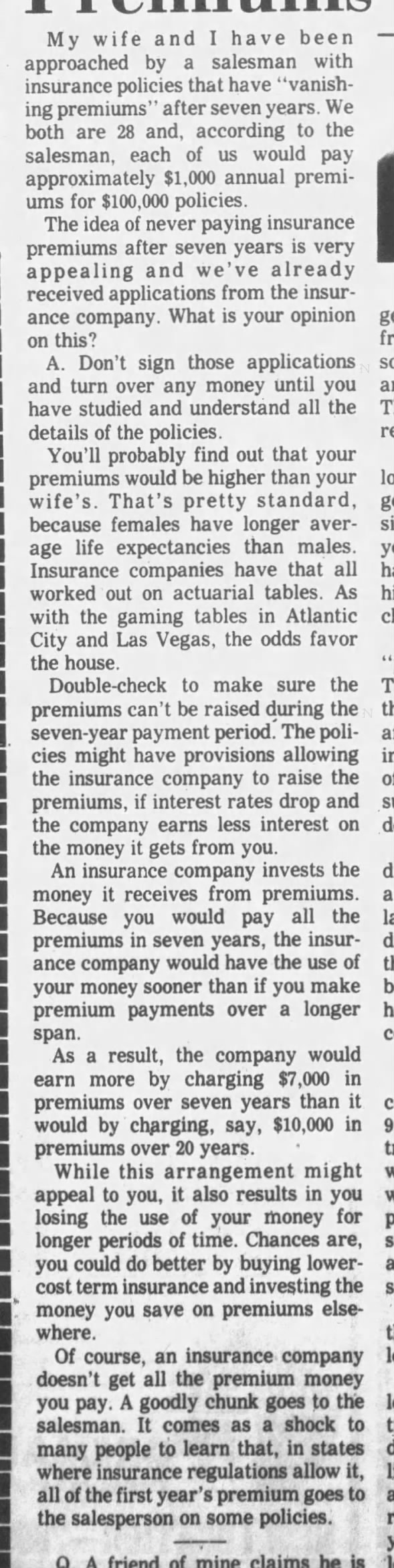
- For example, a common insurance sales pitch several years ago was that the interest earned on the premiums the consumer paid in the early years of a life insurance policy would build up so much that the consumer would be able to stop paying premiums after a certain number of years.
- The claim was based on the unfounded assumption that interest rates would stay high, but this assumption was never disclosed to consumers.
- Only when interest rates rose and the “vanishing premiums” failed to vanish did consumers realize they were defrauded.
- For example, a common insurance sales pitch several years ago was that the interest earned on the premiums the consumer paid in the early years of a life insurance policy would build up so much that the consumer would be able to stop paying premiums after a certain number of years.
2018 03 – NCLC – Consumer Protection in the States: A 50-State Evaluation of Unfair and Deceptive Practices Laws, National Consumer Law Center – 76p
- The standard product we are using is the most popular version of excess interest whole life, which is a high premium version–premium of $13.82 at age 35 (slide 17).
- This is a so-called vanishing premium model where if you pay the premiums for a certain number of years, like six or seven, the policy will in effect become paid up
— Randall P. Mire
1985 – SOA – United States Life Insurance Tax Law, Society of Actuaries – 58p
- Universally omitted from the illustration language was any information about:
- the multiple significant assumptions upon which the illustrations depended,
- the highly leveraged nature and extreme volatility of the vanishing premium products,
- the rate of interest upon which the dividend factor depended, or
- the effect of even slight reductions in the dividend interest rate in causing the “vanished” premiums to “re-appear.”
smithphillips.com/vanishing-premium-litigation
- My next comment relates to the vanishing premium “payback.”
- I guess I’d have to say I’m disappointed that companies haven’t defended themselves more vigorously in this whole situation.
- Maybe the reason is that their agents didn’t do the proper job at the point of sale.
- But if the agent did, and if the agents have a good file, and they’ve been following up since the point of sale/issue and have communicated properly to their clients the impact of interest rate changes on at least an annual basis, I don’t think we would have this problem.
- I found it fascinating that the agent in the Crown Life case got $40 million for mental anguish.
— Kevin A. Marti
1995 – SOA – Sales Illustrations, Society of Actuaries – 14p
- The vanishing-premium concept has been with us since the beginning of the century.
- I’ve seen illustrations of policies in companies that were formed about that time and had things that we sometimes call charter policies, and coupon policies, for example.
- One company I know routinely sold a coupon policy, 20-pay, with the coupons cancelled, which made it a 14-pay.
- That’s a vanishing premium.
- This was brought out, I think, in 1914, so it’s not a new concept, but I’d like to point out one other real problem, and that’s that most of these illustrations are not made up in the home office–they’re produced on laptops in the field.
— MR. SLOAN
1995 – SOA – Practical Illustrations and Nonforfeiture Values, Society of Actuaries – 14p
Charges
Charges
- Administration Costs
- Benefit Charges
- COI – Cost of Insurance Charges
- Expense Charges
- Initial Acquisition Expenses Charges
- Loan Charges
- Net Amount At Risk
- Per Policy Charges
- Per Thousand Dollars Charges
- Premium Loads
- Premium Tax
- 198x – NAIC LIBG – ACLI = Scribe, vs 199x NAIC LIBG – Cude, Kite, Regulators = Scribes
- Lawsuits
- Walker vs LSW
- Per Thousand
- The charges which are characteristic of a universal life contract are …
- Premium Loads are assessed on premiums paid to cover state premium tax, DAC tax and sales related expenses. They are expressed as a percent of premiums and are deducted from premiums upon receipt.
- Monthly Loads can be on a per policy and a per unit basis. They are deducted from the daily interest account or the equity indexed bucket(s) on monthiversaries.
- Cost of Insurance charges are deducted from the daily interest account or the equity indexed bucket(s) on monthiversaries.
2008 0910 – AAA to SEC – Initial Comments on Release Nos. 33-8933 & 34-58022 (File No. S7-14-08): Proposed Rule 151A, American Academy of Actuaries – 67p
- NAIC – Universal Life Model Regulation (MDL-585) – (p4)
- The benefit charges shall include the charges made for mortality and any charges made for riders or supplementary benefits for which premiums are not paid separately.
- The administrative expense charges shall include charges per premium payment, charges per dollar of premium paid, periodic charges per thousand dollars of insurance, periodic per policy charges, and any other charges permitted by the policy to be imposed without regard to the policyowner’s request for services.
- The initial acquisition expense charges shall be the excess of the expense charges, other than service charges, actually made in the first policy year over the averaged administrative expense charges for that
year.- Additional acquisition expense charges shall be the excess of the expense charges, other than service charges, actually made in an insurance-increase year over the averaged administrative expense charges for that year. An insurance-increase year shall be the year beginning on the date of increase in the amount of insurance by policyowner request (or by the terms of the policy).
- Service charges shall include charges permitted by the policy to be imposed as the result of a policyowner’s request for a service by the insurer (such as the furnishing of future benefit illustrations) or of special transactions.