Regulatory
R-Ratio / R-Factor
R-Ratio / R-Factor
- In essence, the model regulation <Universal Life Model Regulation> assumes that at issue, all universal life policies are permanent plans.
- The r-ratio is meant to measure the extent to which the policy is “on track” as a permanent plan.
Statutory Valuation of Individual Life and Annuity Contracts | 5th Edition, Claire, Lombardi and Summers
- Conseco, Garn Lawsuit, R-Factor
- 1988 – SOA – Update on Universal Life Reserves and Non-Forfeiture Values, Society of Actuaries – 36p
- The purpose of the “r” factor, however, is really quite simple.
- If the actual account value is less than the GMF <Guaranteed Maturity Fund>, then future guaranteed policy benefits will run out before the maturity date.
1984 – SOA – NAIC Update, Society of Actuaries – 24p
- The letter “r” is equal to one, unless the policy is a flexible premium policy and the policy value is less than the guaranteed maturity fund, in which case “r” is the ratio of the policy value to the guaranteed maturity fund.
Universal Life Insurance Model Regulation – (#585):
- The funding level affects:
- 1. Universal life commissioners reserve valuation method reserves — In particular the r factor is the ratio of the actual fund value to the guaranteed maturity fund.
- Since r is capped at I00%, using a ratio based on the average fund for all policies may not produce the actual reserve.
- 2. Cash values — The funding level affects cash values since 100% of the surrender charge may not be available on minimally funded policies.
- 3. Premium Assumptions — Different funding levels will have different premium payment patterns, which range from a term level premium to fully funded premium to dump-in premiums. Premium persistency may also vary by funding level.
- 4. Future earnings — As a result of a combination of the above items, future earnings may differ by funding level.
- 1. Universal life commissioners reserve valuation method reserves — In particular the r factor is the ratio of the actual fund value to the guaranteed maturity fund.
1994 – SOA – Valuation Actuary Symposium Proceedings – Session 8 – Life and Deferred Annuity Liability, Society of Actuaries – 32p
Benefits
Benefits
- The main concern was that an unsophisticated buyer purchased a policy and did not know what the coverages, benefits and limitations were.
1988 0603 – Universal & Other New Plans (A) Task Force – NAIC – Attachment Two
1988-2, NAIC Proc.
- Maybe he is not getting all the disclosure he needs, as far as the continuing benefit is concerned, when the interest rates change from that illustrated.
— Gary P. Monnin, Senior Vice President, Chief Actuary of American Founders Life Insurance Company
1982 – SOA – Universal Life (rsa82v8n111), Society of Actuaries – 14p
|
How much do the benefits build up in the policy? How will the timing of money paid and received affect interest? |
 |
2018 0918 – LIBGWG (NAIC) – Brenda Cude Letter / Markup Life Insurance Buyer’s Guide – Revised 2-9-18 for discussion on conference call 2-22-18 –
- LIBGWG – Life Insurance Buyer’s Guide Working Group – (A) – NAIC — [BonkNote]
NAIC Recent Working Groups
-Cude LIBGWG? Markup – What does Benefit mean?
-Life Insurance Buyer’s Guide…. Do your Premiums or Benefits change?
- Product designs can be complex, with benefits contingent on a range of potential risks that may vary over time, as well as with certain guarantees made by the insurer.
2009 1124 – Letter – AAA to GOV (House) Barney Frank (D-MA) / Spencer Bachus (R-AL) – Financial Regulatory Reform Task Force of the American Academy of Actuaries – 3p
- Benefits – ACLI
- Benefits – Actuarial
- Benefits – Consumer Representatives
- Benefits – Industry Groups
- Benefits – NAIC / Regulators
- “benefit charges” – Universal Life Model Regulation (MDL-585)
- Chalke – Benefit Reserves, Benefit Generating Account (BGA), Benefit Generating Function (BGF),
- Current assumptions are critical to interest sensitive products such as Universal Life.
- When interest rates are high, benefit projections (such as cash value) are also high.
- When interest rates are low, these projections are not as attractive.
Supportable
Supportable
- What is supportable is up to the illustration actuary and involves all aspects of the product, not just the crediting rate.
— Donna Megregian
2015 – SOA – Actuarial Guideline 49 (aka Actuarial Guideline YY), by Donna Megregian – pro-iss-93-megregian – Society of Actuaries – 3p
- 1988 – SOA – Are Current Illustrations Supportable?, Society of Actuaries – 20p
- I endorse the idea of giving the Society of Actuaries more power to determine supportability.
- I think the general principles outlined by Harold Phillips (August 19, 1993) are very good in this regard.
- The percent of 80CSO cost index could be used as a practical tool for testing supportability.
- Along with a comparison of the crediting rate to long-term market rates, you have clear ways of comparing cost and growth components.
- The Society of Actuaries could refine definitions of what assumed mortality and interest improvements should not be illustrated.
- If columns of projected values are not allowed with these assumed improvements, then you could still allow a description by the company of what and why improvements may occur. (p352)
— Chris Kite
1994-1, NAIC Proceedings
- Historically, illustrated dividends were understated in sales illustrations and we were spoiled, but in recent years, that doesn’t seem to be the case.
- Our task force feels that there must be more precise definitions and stricter rules governing the definitions of supportability and current experience.
- We took our concerns to the ASB public hearing on March 3, 1993 in Chicago.
- We asked the ASB to review the current actuarial practices and help define and strengthen the definitions and rules regarding supportability of sales illustrations.
- We were expressing our concern not just for the existing downward interest rate market, but for all economic cycles over a long period of time.
— — Robert Nelson, Chairperson of the National Association of Life Underwriters (NALU) Task Force on Illustrations – [Bonk: Currently NAIFA]
1993 – SOA – Sales Illustrations – We Can’t Life With Them, But We Can’t Live Without Them!, Society of Actuaries – 28p
- With regard to nonguaranteed elements at this point, the working group’s position is to show somebody the guaranteed interest rate, which is guaranteed for all years.
- You show them the first-year guaranteed interest rate, which generally is higher, and you can show them the interest rate that you would be paying in renewal years, as long as that interest rate is supportable.
- You might ask what does it mean for it to be supportable?
- We don’t know yet.
- There’s an Academy group that’s working on that.
- Is supportable going to mean the same thing that supportable means in the life insurance model?
- I don’t know.
- Probably something analogous to that but I don’t know.
- You can show a nonguaranteed element, that is the interest rate that we would pay today in renewal years, without showing an illustration, but if you want to show any other nonguaranteed element, then you have to show an illustration, and generally the illustration will follow the same guidelines as for the life model, only it’s going to be simplified, and I hope we can find a way so that we won’t end up with 15-20 page documents as we have with the life model.
— Tom Foley, Insurance Commission
1998 – SOA – Up-to-the-Minute News Flash on Regulatory Developments, rsa98v24n16pd – Society of Actuaries – 18p
- These are examples of a transgression of the definition, as I’ve defined it.
- The Academy committee reporting on the work about annuity illustrations lists as the first supportability objective, “Ensure that information provided by the company creates consumer expectations for nonguaranteed elements that are not unreasonable.” – <WishList>
- Now, I could have stated that better: “As does not create unreasonable expectations.”
- But better still, I’m not sure that illustrations should be creating any expectations other than that there will be something above the guarantee.
- I don’t believe an illustration should create any expectation because that will only get you in trouble, and it detracts from the understanding of what an illustration is and is not.
- An illustration does not show what you can expect.
- This is the corker, I think.
- There was a recent article in Contingency called, “Was Leo Tolstoy an illustration actuary?” – <WishList>
- It was very disappointing to me, although I liked the catchy title.
- It speaks of an illustration as a picture of how a policy is expected to perform over the next several years.
- It talks of a ledger predicting miraculous performance.
- It speaks of assumptions having no relation to the real world.
- All this in an actuarial journal. I have written to the editor. — I haven’t heard from him yet.
- These statements are at odds with our simple definition, and only add to the confusion abounding on the subject.
— Hal Phillips, aka William H. Phillips – a senior life actuary with the California Department of Insurance
1998 – SOA – Current Issues in Sales Illustrations, Society of Actuaries – 26p
Signature
Signature
- The working group next discussed the appropriateness of including a requirement for a consumer signature on the document.
- The group decided it was important not to imply consumer understanding of what was in the illustration but just an acknowledgment of receipt of the illustration.
1994-2, NAIC Proceedings
- I think the only thing the illustration signature will do is to cover us when their lawyers come at us.
1995 – SOA – Practical Illustrations and Nonforfeiture Values, Society of Actuaries – 14p
- 2003 – LC – Fay v. Aetna — [BonkNote]
- Donna Claire – Fay v Aetna – You said you understood it
- I think that requiring the policyholder’s signature does serve a purpose, which is not legal coverage for the company, of allowing the home office to know that the policyholder has received the last page of the illustration that contains the required disclosures.
— H. Lee Michelson
1995 – SOA – Practical Illustrations and Nonforfeiture Values, Society of Actuaries – 14p
- Noel Morgan (Ohio) said he was uncomfortable with the disclosure statement required to be signed by the consumer. He said it took away too much from the consumer.
- Bob Wright (Va.) agreed that this went much further than the working group had intended.
- George Coleman, responded that insurers need to get something out of this compromise also.
- He suggested this would allow companies a little protection.
- — George Coleman, Prudential, ACLI, TRG-Technical Resource Group for the NAIC (Industry Advisory Group – Illustrations)
- Mr. Phillips suggested that the second sentence of the disclosure statement had too much legalese.
1994-4, NAIC Proceedings

2006 DP Darren L Johns v MetLife 43p.pdf
- 240 CHAPTER 28 • Dictionaries, Vocabulary, and Spelling FOR TEACHING: Finding Information in Dictionaries (28a)
- Consider demonstrating the keen usefulness of the information in dictionaries by bringing in a couple of legal contracts – say, from life insurance companies.
- Reading these contracts calls for a sharp eye and a very clear knowledge of what each word means.
- Materials describing one such life insurance plan, for example, contain the following terms: semiannual, net cost, underwrite, waiver, conversion, incontestability, and incapacitated.
- Ask students to define each of these words, without – and then with – the help of a dictionary.
- Which words would they want to make sure they really understood before signing a contract?
- Consider demonstrating the keen usefulness of the information in dictionaries by bringing in a couple of legal contracts – say, from life insurance companies.
2011 – Book – The St. Martin’s Handbook, Instructor’s Handbook – 7th Edition – 492p
Actuarial Guideline 38
Actuarial Guideline 38
- However, it was by no means apparent to many of us in the industry who would be most affected.
- In fact, when I learned of this movement in mid-summer, I called many of the larger writers of universal life products with secondary guarantees, and they told me that they had no knowledge of this movement.
2004-4, NAIC Proceedings
- Project History Revisions to Actuarial Guideline XXXVIII (“AG 38”) – The Application of the Valuation of Life Insurance Policies Model Regulation
2010-Summer, NAIC Proceedings
Reserves
Reserves
- Principles-Based Reserves – PBR
- Premiums and Benefits – Reserves
- Benefit Reserves
- CRVM
- modified reserve systems
- 1967 – SOA – Digest of Discussion of Subjects of Special Interest – Individual Life and Health Insurance, tsa67v19pt2dn5410 – Society of Actuaries – 25p
- Natural Reserves
- PBR
- Policy Reserves
- Terminal Reserves
- 2013 0917 – ThinkAdvisor – ACLI calls Lawsky’s letter on reserves ‘irresponsible’, By Elizabeth D. Festa – [link]
- In a letter to state insurance commissioners, the American Council of Life Insurers (ACLI) called the top New York insurance regulator’s remarks on life insurance reserving “irresponsible” and inaccurate, the former because they erode trust in the state regulatory system and the industry and the latter for actuarial reasons.
- Actuarial Guideline 38 (AG 38)
- Lawsky Letter – Bad Link – https://www.dfs.ny.gov/about/press2013/pr1309111-link.pdf – <WishList>
- ACLI Letter – <WishList>
- asset adequacy approach
- Stochastic
- Linear
- Principles-based
- Commutation Functions
- Asset Shares
- Reserve Factors
- Pricing
- Valuation
- The 1980s ushered in the era of universal life policies.
- While such universal life policy features as flexible premiums, current and guaranteed cost of insurance scales, guaranteed maturity funds and guaranteed maturity premiums added a few wrinkles to the calculation process, the fundamentals of generating policy reserves remained fairly intact.
- In contrast, today’s products have become much more complex. (p11)
2013 01 – NAIC / CIPR Newsletter, By Reggie Mazyck, NAIC Life Actuary – 33p
- 1984-1, NAIC Proceedings, Reserves Examples, CRVM
- 1997 – SOA – A Comparison of Canadian and U.S. Reserving Methods and Their Financial Implications, rsa97v23n28of – Society of Actuaries – 30p
- 1997 – SOA – Equity-Indexed Insurance Products – Pricing, Investment, Accounting, and Reserving, rsa97v23n399pd – Society of Actuaries – 21p
- 1997 – SOA – Term Insurance Reserving, rsa97v23n35pd – Society of Actuaries – 24p
- 2015-3, NAIC Proceedings – 6-203
- Appendix I – Whole Life Net Single Premium Comparison – CRVM Net Single Premiums
- 2016-1, NAIC Proceedings – 6-335
- 20 Year Level Premium Term Life Insurance (Cont. Terminal Reserves for Single Cells – Face Amount
- C. Life Insurance is only Balance sheet where 99% of the reserves (the major liability risk item) include no indication of what the company actually believes about the listed future obligations other than that they are adequate. (p49)
2001 12 – AAA to NAIC – Risk Management in the Insurance Industry – Session 7a, American Academy of Acturies – 51p
- 2008 1120 – NCOIL – Life Insurance & Financial Planning Committee Minutes – National Conference of Insurance Legislators – 6p
- Dave Sandberg with the American Academy of Actuaries (AAA) … said companies in Australia, the United Kingdom, and Canada were subject to principles-based reserving requirements, and had remained solvent despite the far-reaching impacts of a global credit crisis.
- He said the current reserving requirements in the United States hid the real risks.
- Dave Sandberg with the American Academy of Actuaries (AAA) … said companies in Australia, the United Kingdom, and Canada were subject to principles-based reserving requirements, and had remained solvent despite the far-reaching impacts of a global credit crisis.
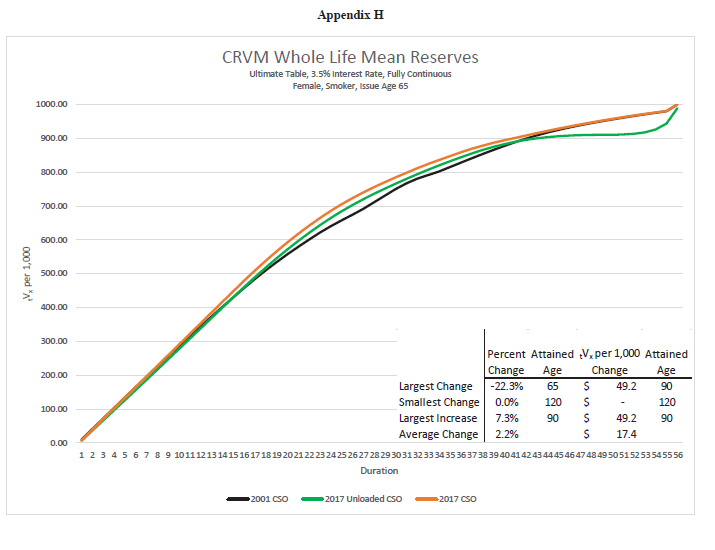 2015-3 Whole Life CRVM Reserves 6-203
 2016-1 20 year Level term 6-335
- 1961 – SOA – Discussion of Subjects of Special Interest: Cash Values, tsa61v13pt2d53 – Society of Actuaries – 3p
- In considering the 1958 CSO revisions, to what extent is it necessary to take into account statutory requirements that cash values be not less than the reserve minus $25 per thousand?
- Our concern relates to the lack of clarity as to the meaning of this paragraph.
- The words “traditional plan” are particularly troubling.
- Does this mean a universal life policy, a whole life policy, or a term policy?
- We are concerned that the vagueness of this wording will once again lead to different interpretations by the reader.
- Also, we are concerned that this wording may be an attempt to hold the same reserves for universal life insurance and whole life insurance, which we strongly believe is incorrect.
- Universal life and whole life are entirely different product structures, with different products features, and consumers buy these products for different reasons and purposes.
- Therefore, reserves for these products should be different.
2004-4, NAIC Proc
- We’re going to actually go through and calculate reserves in detail for this product. The product is a fairly standard product.
- It has a $12.50 per month load.
- It has a guaranteed interest rate of 4 percent.
- It’s a 2001 CSO product, and the current costs of insurance (COIs) are reverse select and ultimate COIs.
- With the COIs, the first 20 years are 90 percent of the guarantees, and then for years 21 and after they are 50 percent.
2005 – SOA – Statutory Financial Reporting for Universal Life, by Jeffrey A. Beckley, Society of Actuaries – 15p
- Vanishing premium whole life is often called … the benefit reserve being something like a statutory reserve and the deferred acquisition expense item …
— Ralph H. Goebel
1985 – SOA – New Product Accounting Alternatives, Society of Actuaries – 26p
- Finally, effective the first of this year, the California Department imposed new requirements for universal life (UL) reserves.
- For a company to which these requirements are applicable, and assuming it opt’s for the Califomia method, things are even more complicated, because statutory reserves are farther away from tax reserves.
- Of course, the results could be even worse if, instead of the California method, the company used reserve interest rates equal to the fund accumulation rate, which is the other option.
— Mark A. Tullis
1992 – SOA – Strategic Product Development, Society of Actuaries – 36p
Commissions
Commissions
- “compensation patterns and product design”
- “Special Compensation” – “incidental advice”
- Renumeration
- levelized commission program
- We designed commission rules that anticipated a relatively large number of rollovers of existing policies;.
- ..full commissions are paid provided the new Universal Life face amount is at least two times the face amount of the replaced policy.
— Phillip B. Norton, not a member of the Society, is Vice President of The Lincoln National Life Insurance Company
1983– SOA – Individual Life Insurance Retention and Replacement Strategies, rsa83v9n417 – Society of Actuaries – 24p
- 1976-2, NAIC Proceedings – p558- – Agents Compensation Systems (C3) Industry Advisory Committee – June 8, 1976 – FIRST REPORT
- The straightforward way to remove these conflicts is to have the agent’s services paid for directly by his client, regardless of what plan or volume of insurance is chosen. It would be desirable, but perhaps not practicable_
to have the agent compensated for services even when a sale of insurance does not follow. - The agent would offer his services to clients as a financial counsellor or insurance specialist. His charges would be on some fee for service basis such as $200 plus $80 per hour of time spent directly on the client’s insurance counselling.
- There would be no commission paid by the insurance company even if life insurance is applied for and issued as a result of the agent’s work.
- This same principle could be extended to the later years of the policy whenever the agent advises his client on his ongoing insurance situation.
- Our studies show that by transferring the agent’s compensation from the premiums for life insurance to the client directly, it is possible to compensate the agent adequately for his activity and reduce the cost of insurance substantially as well.
— J. Ross Hanson
1976 – SOA – Agent’s Compensation: Individual and Group Aspects, Society of Actuaries – 23p
- On the high side of the commissions, I am aware of commission scales running significantly above 100% of target premium in the first year.
- Leaving aside my personal biases about commissions exceeding 100% of premium, I am amazed at the apparent competitiveness of some of the products offering these commissions.
- My conclusion is obvious, such products are either underpriced or illustrated unreasonably — maybe both.
— Rex D. Hemme, with a subsidiary of Lincoln National Life Insurance Company
1989 – SOA – Mass Marketing — Competitive Strategies, rsa89v15n227 – Society of Actuaries – 14p
- [Commission Disclosure]
- Angele KHACHADOUR (attorney with the firm of Miller & Daar, Mill Valley, CA): The moment you talk about disclosing one portion of that premium, you’re going to have to start disclosing the rest of that premium and the allocation of every penny in that dollar.
- It’s not fair to identify just the agent’s compensation, and have him confess publicly to getting 100% of the first year premium.
- We agreed earlier that the buyer just looks at the overall price.
- Barbara LAUTZENHEISER: The consumerists I have heard talk, seem to be more concerned about the compensation to the agent than they have been about other specific costs within the policy.
1981 – SOA – The Life Insurance Business—The View of Consumerists (rsa81v7n17), Society of Actuaries – Daphne Bartlett- Moderator – 16p
- 1973 – AP – Problems in Agents’ Compensation, by Harold G. Ingraham, Jr., The Journal of Risk and Insurance, Vol. 40, No. 2 (Jun., 1973), pp. 191-208 (18 pages), Published By: American Risk and Insurance Association – [JSTOR]
- 1976-4, NAIC Proc. – Life Agents’ Compensation Task Force
- 1979 – SOA – Future Trends and Current Developments in Individual Life Products (rsa79v5n44), Society of Actuaries – 24p
- 1981 0921 – GOV (House) – Insurance Agent Commission Deregulation – [PDF-109p-GooglePlay,
- 1983 – SOA – Individual Life Insurance Retention and Replacement Strategies, rsa83v9n417Society of Actuaries – 24p
- 1990 – LR – Statutory Prohibitions on the Negotiation of Insurance Agent Commissions: Substantive Due Process Review Under State Constitutions, Robert H. Jerr, II and Reginald L. Robinson – 50p
- 1990 – SOA – Designing a Field Compensation Structure, rsa90v16n29. – Society of Actuaries – 22p
- 1998 – SOA – Insurance Compensation Trends and Outlook, rsa98v24n131if.pdf – Society of Actuaries – 27p
- Mr. Birdsall asked if the agent compensation structure for IUL products provide greater incentives for agents than is provided by the compensation structure of traditional universal life (UL) products.
- Mr. Samuelson (MetLife) said that a compensation study he had previously conducted found that, on average, IUL policies have a target premium 80% higher than the average target premium for UL products.
2014 1114-15, NAIC Proceedings – IULWG – 6-63
- William Albus (National Association of Life Underwriters – NALU) commented that:
- …the requirement for disclosing sales commissions is unnecessary because it is superfluous and would only confuse consumers.
- …the purpose of disclosure is to provide information for making an informed decision and the disclosure of sales commissions has nothing to do with making this decision.
1988-2, NAIC Proc.
- From a distribution perspective, I think one of the challenges that face us in UL is the servicing of UL.
- Flexible premium, high-degree-of-service UL products have little or no renewal compensation paid if there’s no premium paid.
— Daniel F. Byrne, M Financial
1999 – SOA – The Next Generation Universal Life, Society of Actuaries – 30p
- Longer guarantees with corresponding higher gross premiums further increase commissions.
- There is an incentive for agents to sell longer guarantees even when they are not needed.
— Brian Kavanagh
1995 – SOA – VASP – Life Valuation Issues — XXX / Regulation 147, VASP9514 – Society of Actuaries – 16p
- The other question I have, coming from the standpoint of a mutual company, is that with our agency system it would be hard for us to replace whole life insurance with a commission rate that is around the level of a YRT commission plus 3% of premium.
- That is about 10% of what we are now paying in the first year on a permanent insurance plan.
1979 – SOA – Future Trends and Current Developments in Individual Life Products (rsa79v5n44), Society of Actuaries – 24p
- 1995 – LC – Reich (Secretary of the United States Department of Labor) v. Lancaster, 55 F. 3d 1034 – Court of Appeals, 5th Circuit – Google Scholar
- Reich v. Lancaster, 843 F.Supp. 194 (N.D.Tex.1993).
- The Secretary predicated the instant civil enforcement action on two aspects of these transactions that are germane to this appeal.
- First, he alleged that the Fund had paid excessive and unwarranted premiums in purchasing individual permanent or whole life policies, when the Fund could have obtained the same or better benefits for Fund participants and beneficiaries by obtaining other types of insurance, such as group term life insurance, at far less cost.
- Second, the Secretary contended that Lancaster, his sons, JDL, and DCI had received more than reasonable compensation in connection with the insurance purchases.
Unbundled
Unbundled
- The “unbundling‘ of services and other product differences between Universal Life and Ordinary Life cause current literature to be inapplicable, as well as insufficient, for Universal Life.
1984 – Journal – AAA – American Academy of Actuaries
- I would like to ask how many people here have received requests for such unbundling from the public. (No hands were raised.)
— Walter Miller [Prudential]
1981 – SOA – Equity for Existing Policyowners, Society of Actuaries – 24p
- 1983 – SOA – Product Unbundling Strategies, Society of Actuaries – 14p
- 3) Since Universal Life is an “unbundled” product, the cost of each of the elements is disclosed to the buyer.
- Consumers have demonstrated their unwillingness to commit dollars to heavily loaded products.
1982 – SOA – The Universal Life Update (rsa82v8n22), Society of Actuaries – 16p
- John Dinius (Aetna) said that he represented a universal life company and said that an illustration that unbundled everything would look more complicated and that would affect sales.
1995-1, NAIC Proc.
- Higher interest rates and inflation have reduced the market share for the traditional life insurance products.
- There appears to be an “unbundling” of the insurance and investment features of the life insurance product. Level premium, whole life, cash value insurance is giving way to a combination of term insurance with an investment element in short-term securities or equities.
1983-2, NAIC Proceedings
- There are certain constraints which automatically bind a universal life policy when you take this narrow approach.
- The first one is that if, in fact, the policy is an unbundling of the reserve structure, the gross premium after removing policy loads (the premium actually deposited into the fund) must equal the valuation net premium.
— Shane Chalke
1984 – SOA – NAIC Update, Society of Actuaries – 24p
- Unbundling
- Because the policyholder must generally pay premiums in advance, virtually all insurance contracts have an implicit or explicit deposit component that would, if it were a separate instrument, be within the scope of IAS 39.
- Some examples of deposit components are:
- (b) components for which a policyholder assumes all or most of the investment risks (as with some types of unit-linked (variable) contract).
- (c) an interest-bearing account value, as in some universal life contracts.
No. 1540-100 ⏐ AUGUST 2, 2007 – Financial Accounting Series – INVITATION TO COMMENT
Complaints
Complaints
- (p33) – Bob CORKER (R-TN) – You know, there are very few complaints.
- I mean, life insurance is not what drives complaints at your State Insurance Commissioner’s officer, really, is it? It is just a small percentage, is it not?
2009 0317 – GOV (Senate) – Perspectives on Modernizing Insurance Regulation, Chris Dodd (D-CT) — [BonkNote]
- They are complaints about things that we can’t do anything about because the contract might be a universal life type product with nonguaranteed elements, and there is no regulatory framework to deal with those issues.
- Those complaints just fall by the wayside because there is nothing that can be done.
— Larry Gorski, Illinois Insurance Department – Actuary
1996 – SOA – Nonforfeiture Law Developments, Society of Actuaries – 23p
- (p8) – An increase in the number or type of complaints filed by policyholders, claimants, employees, agents or third parties which could indicate liquidity or internal control problems (consumer affairs).
1998 – NAIC – Financial Analysis Handbook – 349p
- The Financial Analysis Handbook (the Handbook) was developed under the direction of the NAIC Financial Analysis Handbook Working Group.
- (p8) – 33 percent of the sales complaints concerned misrepresentation by agents in the course of a sale.
- (p12) – Such complaints were not new, but due to recent media attention and other factors, have been received and handled in large numbers.
- (p) – There is ample evidence to suggest that many of the practices at Prudential are, or were, present at other life insurers.
1996 – Report of The Multi-State Life Insurance Task Force and Multi-State Market Conduct Examination of The Prudential Insurance Company of America – By the Examiners of The Multi-state Life Insurance Task Force From Several State Departments of Insurance and other State Regulatory Agencies – 270p — [BonkNote]
- Teresa Winer (GA) – asked if it would be useful to ask states whether they have received consumer complaints about the summaries.
- Richard Wicka – Chair (WI) – said that it would be helpful to have that kind of information but that he is not sure it would be possible to track down complaints to that level of detail.
2016-2, NAIC Proceedings – LIIIWG – Life Insurance Illustrations Working Group
- 1966-2. NAIC Proceedings
- (p605) – Advertising of Insurance (H) Committee
- The Honorable S. Roy Woodall, Jr., of Kentucky presented the report of the NAIC-FTC Resolution (H1) Subcommittee for consideration by the parent Committee.
- (p607) – Report of the Results Obtained from Questionnaire Forwarded to Individual Members of the NAIC by the (H1) Subcommittee – To Study NAIC-FTC Resolution
- 27 States answered that complaints were primarily involving LIFE INSURANCE CARRIERS.
- 7 States answered that complaints were primarily involving LIFE and ACCIDENT and HEALTH carriers.
- 6 States answered that complaints were primarily involving ACCIDENT AND HEALTH carriers ONLY.
- 5 States answered that complaints were involving BOTH life and property companies.
- 1 State answered that complaints involved LIFE, PROPERTY and ACCIDENT AND HEALTH COMPANIES.
- 7 States answered that they had received NO complaints.
- NAIC-FTC Resolution adopted in 1963
- 2022 0929 – icae.com – Session Topic: Complaint Topics & Trends – 11p
- Facilitator: Becca Donegan, Erie Insurance
- Panelists: Andy Case, Mississippi DOI; Dusty Smith, Alabama DOI; Deidre Backues, Shelter Insurance and Matt Stiles, EquiTrust
- Universal Life Insurance:
- There is a lot going on this this space. Confusion about coverage because it is a product that needs to be managed and many complaints center on the interest rate return.
- Diminishing values linked to stock market performance and universal life illustrations are difficult to read/confusing.
- Most consumers don’t understand that it is a blended product.
- 12. Section 11: Participation in National Market Conduct Databases Administrator said the terms “confirmed” and “unconfirmed” should be retained since the concept of “confirmed complaints” is used for the NAIC’s Consumer Information Source (CIS) and the NAIC’s Market Analysis Handbook.
- Both the CIS and the Market Analysis Handbook define the phrase “confirmed complaints” through the NAIC’s Complaint Database System (CDS) complaint disposition codes. p1024
2004-2 – NAIC Proceedings
- Senator Howard Metzenbaum (D-OH):
- Mr. Rips,** you testified that last year the largest group of complaints that you received about life insurance came from people whose policies didn’t have the amount of cash value that they had been told and were shown.
- l am talking about illustrations like those on the charts in this room.
** Geoff Rips, public information director, Texas Office of Public Insurance Counsel
1992 0623 – GOV (Senate) – Consumer Disclosure of Insurance, Howard Metzenbaum (D-OH) — [BonkNote]
- (p8) – Our job is to follow those complaints and address them in our marketplace and make that marketplace work for consumers at the local level.
— NAIC – Joel S. Ario, Insurance Administrator, Oregon Insurance Division, Secretary Treasurer, National Association of Insurance Commissioners
2003 0506 – GOV (House) – Increasing the Effectiveness of State Consumer Protection, Sue W. Kelly (R-NY) — [BonkNote] — [PDF-123p, VIDEO-?]
- Over the last five years, DFS has received almost 1,400 complaints from New York consumers about universal life insurance policies.
- Many consumer groups and media organizations have also reported consumer issues with universal life insurance.
2019-? – New York – Department of Financial Services – Consumer Alert – [link]
⊃ 2019 – ThinkAdvisor – New York Financial Superintendent Lacewell Warns of Hidden Costs in Universal Life Policies, By Elizabeth Festa – [link]
- 2000 06 – NAIC – Consumer Complaints White Paper, Consumer Complaint White Paper Working Group was appointed by the Market Conduct and Consumer Affairs (EX3) Subcommittee – 66p
- Monitoring of litigation may alert regulators to issues that the regulatory system has not yet addressed.
2008-3, NAIC Proc.
- He said the consumer complaint analysts in a state are a “focus group” that each state should rely on.
2009-3, NAIC Proceedings
⇒ He = Joel Ario – Pennsylvania Insurance Commissioner
- One problem area in a lot of policies has been interest rates.
- A slow cumulative, very large decline in interest rates has affected everything.
- Why are we getting so many complaints?
- Did the policyholder expect rates to stay the same forever?
- Did the agent or the company mislead?
- Did the policyholder think we were promising?
- He shouldn’t have, I hope he didn’t.
— Bruce E. Booker, Life of Virginia, a member of the American Council of Life Insurance (ACLI) Task Force on Cost Disclosure and the National Association of Insurance Commissioners (NAIC) Advisory Group on Illustrations
1993 – SOA – Sales Illustrations – We Can’t Life With Them, But We Can’t Live Without Them!, Society of Actuaries – 20p
- Most state insurance regulators generally only conduct investigations of insurance company sales practices when they receive customer complaints.
- Although some state insurance regulators review insurance companies’ product sales practices as part of market conduct reviews, few insurance products are subject to any suitability or appropriateness standards. (p11)
2005 11 – GAO – Financial Product Sales: Actions Needed to Better Protect Military Members, Government Accountability Office – 88p
- Complaints and inquiries related to life insurance and annuity products were less frequent, and generally concerned consumer dissatisfaction with, or confusion regarding, universal life insurance policies. (p90)
2018 – Wisconsin Insurance Report – 219p
- (p187) – Chuck GRASSLEY (R-IA) – Generally speaking, what has been the experience in the State of Iowa with regard to the problems of consumer disclosure of life insurance?
- David Lyons – (NAIC / Iowa Insurance Commissioner). If I can be generic, we have had two major problems.
- The first is a very specific problem, and that is the changing in the interest rates.
- We have seen a large upsweep in the number of complaints exactly on point to the testimony that we have heard here today relating to the change in dividends and interest structures.
- So we have had a lot of work to do in the area of determining whether there were intentional misstatements.
- In that case, there are civil and administrative actions taken by us and criminal prosecutions referred on.
- ⇒ If there is an unintentional, yet identifiable, misleading statement made to consumers, then there is administrative action taken to put the consumer into the position they should have been under the information that was disclosed to them.
1993 0525 – GOV (Senate) – When Will Policyholders Be Given The Truth About Life Insurance?, Howard Metzenbaum (D-OH) — [BonkNote]
- (p130) – 1980 0130 – Letter – ACLI to GOV (Senate) Howard Cannon (D-NV) – American Council of Life Insurance
- DEAR SENATOR CANNON: Enclosed is a copy of the response of the American Council of Life Insurance to the comments by the Federal Trade Commission on the Council’s testimony on the Commission’s life insurance cost disclosure report which was issued on July 10, 1979. Sincerely, Robert Bland Smith, Jr.
- The staff of the Federal Trade Commission has chosen to respond to eight of the criticisms of the staff report made by representatives of the life insurance business at the October 17, 1979 hearing of the Senate Committee on Commerce, Science and Transportation. These responses merely repeat the erroneous ideas and conclusions that were set out at length in the FTC staff report.
- We should like to offer a few comments pointing out what we see as flaws in the responses of the FTC staff in order to clarify some of the matters under dispute.
- Our comments will follow the same sequence used by the FTC staff.
- 8. The Federal Trade Commission should not be involved in the life insurance area because it has not received a sufficient number of consumer complaints.
- Predictably, the FTC staff responds that “consumer complaints do not always provide an accurate gauge of consumer problems.”
- DEAR SENATOR CANNON: Enclosed is a copy of the response of the American Council of Life Insurance to the comments by the Federal Trade Commission on the Council’s testimony on the Commission’s life insurance cost disclosure report which was issued on July 10, 1979. Sincerely, Robert Bland Smith, Jr.
1979 0710 and 1017 – GOV (Senate) – FTC Study of Life Insurance Cost Disclosure, Senator Howard Cannon (D-NV) — [BonkNote] — [PDF-592p]
- 2000 – LR – The Filed Rate Doctrine and Insurance Fraud Litigation, by Allan Kanner – 33p
- (p) – As these cases illustrate, insurers are often sued for fraud and bad faith.
- (p31) – 169. This is also the view of other states. See, e.g., In re Prudential Ins. Co. of Am. Sales Practice Litig., 148 F.3d 283 (3d Cir. 1998) (illustrating that private litigation is the primary watchdog that wakes up state regulators).
- The Prudential court observed that Prudential’s illegal activities first came to light through private lawsuits filed in early 1994, which triggered a front-page news article.
- <WishList> – See Leslie Schism, Fine Print Victims: Some Agents ‘Churn’ Life Insurance Policies, Hurt Their Customers, WALL ST. J., Jan. 3, 1995, at 1. In April 1995, more than a year after the first private suit, the Multi-State Life Insurance Task Force was formed. Id.
- ⇒ Prudential shows that private claims for relief are absolutely crucial to ensure that victims of insurance fraud receive restitution. Id.
- <WishList> – See Leslie Schism, Fine Print Victims: Some Agents ‘Churn’ Life Insurance Policies, Hurt Their Customers, WALL ST. J., Jan. 3, 1995, at 1. In April 1995, more than a year after the first private suit, the Multi-State Life Insurance Task Force was formed. Id.
- (p521) – Mr. Weber suggested that the illustration show … how the policy values are paying the premium.
- Mr. Morgan said that this issue needs specific attention because many complaints were received in the state insurance departments on this issue.
* Richard Weber, Merrill Lynch Life
1994-3, NAIC Proceedings – Life Disclosure Working Group – NAIC
- An increase in the number or type of complaints filed by policyholders, claimants, employees, agents or third parties which could indicate liquidity or internal control problems (consumer affairs). (p8)
1998 – NAIC – Financial Analysis Handbook – 349p
- The Financial Analysis Handbook (the Handbook) was developed under the direction of the NAIC Financial Analysis Handbook Working Group.
- Teresa Winer (GA): I’m guessing that, perhaps, this came out of the fact that Illustrations were not as clear.
- Maybe there’s been complaints.
- And the purpose of this entire committee was to provide some kind of summary to make it a little bit more clear.
2019 0903 – NAIC – LIIIWG – Life Insurance Illustrations Working Group, Conference Call – [Bonk: Not in Proceedings]
- Complaint Index is a measure which can be used, along with other measures, to evaluate how well a company does in the
marketplace compared to other companies. (p277)
1995-4, NAIC Proceedings – Market Conduct and Consumer Affairs Subcommittee
- John PEARSON (ACLI) – Our records say less than 10 percent of complaints are life insurance and life insurance-related.
- Having said that, however, we frankly think the current network does a very good job of handling consumer complaints.
- We would prefer for more uniformity across States with some of these model laws that have passed
- But, frankly, we look at it as something that we could build upon as through the Federal bill that we would expect nothing less than an exemplar customer complaint and recourse. (p29)
2008 0729 – GOV (Senate) – The State of the Insurance Industry: Examining the Current Regulatory and Oversight Structure – The Current State of Insurance Regulation, Oversight and Ways to Enhance Consumer Protection, Promote Competition and Efficiency, and to Address What Role, if any, the Federal Government should play – [PDF-472p, VIDEO-Senate-Error]
- Judy Faucett: We contacted a number of regulators during the course of our research.
- The California department was gracious enough to pull 80 complaints that they had received from consumers in the last year, a random 80 complaints.
- Out of those 80 complaints on life insurance, they determined that 35 of them were illustration-related.
- Fifty-five percent were for reasons you would have expected; that is, the premium didn’t vanish when it was supposed to, or the dividends that were paid weren’t as high as what was illustrated.
- The other 45% believed that they had bought an annuity product and didn’t even know that they had life insurance?
- Maybe there is something that we’re not communicating to buyers out there.
- We may think that our illustrations are straightforward, but somehow the people who aren’t actuaries or agents or who just don’t understand insurance, are missing the point.
- Admittedly, not everybody complains, but the number was a lot higher than we had expected, and it was a very different type of complaint than we had expected. (p10)
- The California department was gracious enough to pull 80 complaints that they had received from consumers in the last year, a random 80 complaints.
1991 – SOA – Illustrations, Society of Actuaries – 20p
- 2000 – NAIC – Suitability of Sales of Life Insurance and Annuities – 33p
- Information available from the NAIC, including the following, should be reviewed:
- Examination Jumpstart Reports;
- Special Activities Database (SAD)
- Regulatory Information Retrieval System (RIRS);
- Complaints Database System (CDS) and Complaint Index Report;
- Examination Tracking System (ETS); and
- Financial Analysis and Solvency Tracking System (FAST).
2009-3, NAIC Proceedings
- Commissioner Tyler said that because one consumer complaint often means that other consumers are also harmed by a particular practice, he would like to know the relationship between consumer complaints and proper market regulation.
- He said market regulators should leverage consumer-complaint data to ensure that what happens to one consumer is not happening to others.
2009-3, NAIC Proceedings
- (p8) – Insurance is a different kind of product than either banking or securities or really any of the other financial products out there.
- It is a more complex kind of product.
- What kind of policy will be offered to the consumer? What will be the price of the policy? What are the specific policy terms and conditions? What is included, what is excluded from the policy? What does the fine print say? Is a claim valid when it is filed? If it is valid, how much is it worth? These are all questions that are very complicated
- They often lead to misunderstandings between consumers and insurers
and they often lead to consumer complaints to our offices. - …
- Our job is to follow those complaints and address them in our marketplace and make that marketplace work for consumers at the local level.
2003 0506 – GOV (House) – Increasing the Effectiveness of State Consumer Protection, Sue W. Kelly (R-NY) – [PDF-123p, VIDEO-?] –
- House – Committee on Financial Services – Subcommittee on Oversight and Investigations

- Examples include:
- Complainants were sold a whole life policy that provided no short-term liquidity except through loans or surrender.
- The complainants were in their sixties at the time that the policy was sold.
- Their stated purpose for purchasing the policy was to provide an income stream upon retirement.
- The whole life product did not meet these needs and the Department (Vermont) was able to reverse the transaction. (p125)
2000-1, NAIC Proceedings
- Once the companies, producers and products are in the marketplace, state consumer service personnel monitor the way in which the marketplace operates by handling consumer inquiries and consumer complaints.
- The consumer service representatives in state insurance departments are truly the “front line” regulators, as they interact with consumers on a daily basis.
- In addition to responding to specific consumer concerns, state consumer service representatives also conduct educational outreach efforts.
2012 – NAIC – Existing U.S. Corporate Governance Requirements – 22p
- Some vague idea of the quality of service to policyholders can be gained from the number of policyholder complaints received, but this is a crude measure at best and represents a measure more of the total breakdown of service than of its quality.
— Kenneth R. MacGregor
1971 – SOA – Mutual Life Insurance Companies–Their Objectives and Operating Philosophy, Society of Actuaries – 250p
- (3) A task force of the Unfair Trade Practices (B4) Subcommittee is considering uniform complaint procedures for state insurance departments.
- Under a pilot project, several departments have reported complaints by company, type, line, Reason, disposition, etc. on a uniform format to the Central Office.
- This information will be fed into a computer and reports generated for the departments so as to identify and document problem companies, evaluate complaint handling procedures, identify unfair trade practice problems, etc.
1974-1, NAIC Proc,
ATTACHMENT ONE-A1
TO: NAIC Members
FROM: Robert E. Wilcox, Chair, Life Disclosure Working Group
DATE: January 21, 1996
RE: Life Insurance Illustrations Model Regulation
- In December the NAIC membership adopted a new Life Insurance Illustrations Model Regulation to address some of the problems we have all been experiencing as consumers complain that their “vanishing” premiums haven’t vanished and the high returns they expected haven’t materialized.
1996-1, NAIC Proc.
- …..system of monitoring to assure consumer satisfaction should be designed.
- He asked members of the working group to consider an appropriate mechanism to achieve effective monitoring.
1991-1A – NAIC Proceedings, Life Marketing Practices to Senior Citizens Working Group
- After a great deal of discussion, it was pointed out that the Data/Systems Management (EX4)Task Force specifically rejected any priority development within the next two years for an NAIC complaint data base system.
- Mr. Connor noted that he has stressed for a number of years that a complaint data base system was important and needed to be given priority attention by the NAIC.
- As was pointed out to the Data Systems Management Task Force, a data base was discussed 10 years ago after criticism was leveled at the NAIC by the General Accounting Office.
- In his report to the Data/Systems Management Task Force in June in Cincinnati, Mr. Connor pointed out that there was mounting pressure in Congress for the NAIC to collect complaint data for Medicare supplement coverages.
- It was the consensus of the subgroup then, as it is today, that it would be very short sighted to develop a system for a nationwide complaint system for merely one line of business when the problem crosses all lines.
- The Data/Systems Management Task Force was reminded that the background work on such a system had been completed and that a modified NAIC Uniform Complaint Filing Form is in place awaiting to be computerized onto an on-line system.
- In summary, it was the consensus of the subgroup that they are in wholehearted agreement and support of the concept behind the collection of complaint information as requested by the Medicare Supplement Working Group.
- However, a decision to proceed on the development of a complaint data base merely for Medicare supplement insurance would be tantamount to building a large jetliner merely for the purpose of carrying one passenger.
- The development of an on-line complaint data base on all lines of insurance readily accessible to the states, is a sine-qua-non for the competent scheduling of market conduct examinations.
- If the states are to adequately monitor the marketplace and sales abuses such as are seen in the Medicare supplement markets, the NAIC must give high priority to the implementation of such a data base.
- Such a data base is as essential to market conduct needs as the Insurance Regulatory Information System (IRIS) is to financial examinations. (166)
1990-1A, NAIC Proceedings
- (p7) – There were 6,118 insurers in the U.S. (including territories) in 2014, including 2,583 P-C insurers, 1,752 life-health (L-H) insurers, and 1,783 other insurers and related agencies.4
- Given the objective to gauge the service quality of insurers by using the volume of consumer complaints, our analysis focuses on the P-C insurers.
- Consumer complaints within the L-H industry may correlate only weakly with consumer experience, due to the obvious disconnect between purchasers and beneficiaries of these insurance policies-under life insurance policies claimants typically are not the policy buyer…
2016 – AP – Financial Intermediaries and Consumer Complaints – 61p
- Commissioner Tyler said that because one consumer complaint often means that other consumers are also harmed by a particular practice, he would like to know the relationship between consumer complaints and proper market regulation.
- He said market regulators should leverage consumer-complaint data to ensure that what happens to one consumer is not happening to others.
- Mr. Mealer said complaints are included in the adopted market analysis process.
- Ms. Baker said the Market Regulation Handbook includes the use of consumer-complaint data in the market analysis process.
- Commissioner Ario said there are two methods of analyzing consumer complaints.
- He said the first method is to perform statistical analysis of the complaint data and the second method is to have ongoing discussions with a state’s complaint analysts.
- He said the consumer complaint analysts in a state are a “focus group” that each state should rely on.
- Mr. Narcini said that because the adopted processes included the use of consumer complaints, they are not specifically mentioned in the proposal.
- Commissioner Tyler said the requirement in the proposal that a state hold certain items confidential should be eliminated.
2009-3, NAIC Proceedings
- 4. Discuss Complaint Reconciliation Survey – Next Steps
- Mr. Belo said the survey is a compilation of all states that have responded to the survey question whether a complaint reconciliation process is in place in their state.
- He said the question put before the Working Group is whether a best practice regarding complaint reconciliation should be developed.
- Ms. Brown said the survey shows that there is quite a range among state insurance departments of complaint reconciliation processes.
- She offered to present Colorado’s complaint reconciliation process as a model for other states to follow.
- Mr. Ewen said this issue is in the current market regulation accreditation proposal being reviewed by the Special Accreditation Standards Working Group.
- He said the Working Group needs to determine the best place for discussion of this issue.
- Ms. Krier said this issue is not currently on the Market Analysis Procedures Working Group’s agenda, and suggested that this issue be forwarded up to the D Committee for review and to determine what Working Group is the appropriate venue for discussion.
- Commissioner Ario said that since complaints are a part of market analysis, guidance needs to be provided by the D Committee with regard to which Working Group will work on this issue.
- He said the same group that is reviewing the ICAE paper needs to review the complaint reconciliation survey as well.
- Commissioner Ario said that he would bring this up at the Special Accreditations Standards Working Group meeting Sept. 22, as well as to the Market Regulation and Consumer Affairs Committee for their consideration. He will report any discussion on this issue back to the Working Group at the next
scheduled conference call.
- Mr. Belo said the Working Group can then proceed with how to form best practices with regard to complaint reconciliation.
2009-3, NAIC Proceedings
- But what kinds of things led to the Armstrong investigation?
- Back at the turn of the century, many companies were illustrating very large 20th-year dividends, with the thought that they wouldn’t really have to pay them because not many people would be around to collect the dividends or to be upset at lower dividends.
- There were at least a couple of problems with this.
- For one thing, they weren’t setting up liabilities for those deferred dividends.
- We now have line 8 on page 3 of the NAIC Annual Statement to deal with that.
- Another problem was that the actual dividends often turned out to be considerably less than illustrated.
- Yet some of the companies, even as they were paying those lower dividends, were still illustrating the higher ones on new business.
- In simplest terms, people were paying for insurance on the strength of quasi-promises, the details of which they didn’t fully understand.
- Ultimately the regulators intervened and stopped such products from being sold at all, at least in New York.
- For one thing, they weren’t setting up liabilities for those deferred dividends.
- The question, of course, is whether that sort of thing could happen again.
- There are more recent parallels as well.
- One of my coworkers recently mentioned to me that back in the late 1940s and early 1950s, it was a common assignment for fledgling actuarial students to compose explanatory letters to policyholders who had written in to complain that the dividends on the 20- or 30-year endowments they had bought had not materialized.
- This was, of course, due to the low interest rates of the 1930s and 1940s.
— Benjamin J. Bock, Transamerica Occidental
1992 – SOA – Life Insurance Sales Illustrations, Society of Actuaries – 16p
Illustrations – Uses
Illustrations – Uses
- 2015 0816 – NAIC – LIAC CC, NAIC Proceedings
- Birny Birnbaum (Center for Economic Justice-CEJ) also expressed support for the suggestion.
- He said it is important that state insurance regulators determine if illustrations are accomplishing what they are intended to accomplish, how they are being used and whether consumers understand them.
- Mr. Birnbaum also suggested that illustrations should be consumer-tested
- Birny Birnbaum (Center for Economic Justice-CEJ) also expressed support for the suggestion.
- Question: Should Illustrations be used to compare poilcies? What is the purpose of Illustrations?
- YES – Mr. Foley responded that, if consumers want to compare policies, they have the illustrations to do so. — 1999-4 NAIC Proceeding
- YES – NAIC Working Group Actuary, Illinois?
- No – Texas Insurance Commission Rep? “I hope not.”
- As we began researching this problem, two questions became central.
- What criteria should we use to evaluate suggested changes and alternatives?
- What is the root cause of current problems, and why have previous corrective efforts been so unsuccessful?
- As research continued, at some point we started to focus on the uses of life policy illustrations.
- This proved to be a key concept in addressing those two major questions.
- First, let’s list the major user groups: (1) consumers, (2) agents and brokers, (3) life companies, and (4) third-party analysts.
- We are all familiar with the first three groups.
- The third-party analyst is a more recent phenomenon and could be a CPA, consulting….”
— John R. Skar, Fidelity Mutual
1991 – SOA – Illustrations, Society of Actuaries – 20p
- For Sales / Replacements vs Managing Performance
- Walker v LSW – Consumer Survey Expert
- 1991-1992 – SOA – Final Report* of the Task Force for Research on Life Insurance Sales Illustrations: Under the Auspices of the Commitee for Research on Social Concerns – Judy Faucett (Chairperson), tsr917 – Society of Actuaries — [BonkNote] — 142p
- Appendix II – Illustration Examples
- *Opinions expressed herein are those of the Task Force for Research on Life Insurance Sales illustrations and of the Committee for Research on Social Concerns. This report does not purport to represent the views of the Society of Actuaries or of its Board of Governors.
- Benjamin J. Bock, Bruce E. Booker, John W. Keller, John R. Skar, Linden N. Cole
- In considering the specific questions posed by the Subgroup, we found it helpful to take a step back, and to first consider two more fundamental questions:
- (A) What is the purpose of illustrations? (p6-844)
- Although illustrations can be used for many purposes, the following seem primary to us:
2019 310 – Letter – AXA Equitable (Brian R. Lessing) to NAIC IULISG – Indexed Universal Life Illustrations Subgroup (Fred Andersen – Chair) – 2019-3, NAIC Proceedings
-
Churning will be high as comparisons of recent performance and illustrations will “prove” the necessity for a switching.
— Dale R. Gustafson, Northwestern Mutual
…asks why the really hard questions about the product aren’t reflected in the articles we printed. His nominees for the hard questions are:
1981 11 – SOA – The Actuary, Society of Actuaries – 6p